Sweet Dreams Are Made of This: Tips to help you sleep

Read Time: 1 min

Do you want to be a millionaire? You need to wake up at 5am. Otherwise, you’re doomed to destitution. Countless posts on Tiktok will advise that the only way to be successful is to wake up before the sun rises. But rewinding several millennia, our ancestors had different ideas.

The ancient Egyptians valued sleep. For them, the act of sleep, and more importantly, the act of dreaming, provided a gateway to lands beyond the living. Sleep was the only place one could connect with the gods and truly transform. They built temples specifically for sleeping (as did the ancient Greeks), and the content of these dreams could guide the decisions of families, armies and entire dynasties.

Most people have stopped associating sleep with profound spiritual transformation. But the effects of sleep deprivation have been more widely studied than ever before. A lack of sleep degrades cognitive processing, creates erratic moods, and causes problems with immune function and digestion. Not sleeping at all is fatal. Fatal insomnia is a rare genetic condition that stops a person from being able to fall asleep at all. The prognosis is not good. Everyone dies within a year of onset.

Whether you are interested in caressing the space between the living and the divine lands, or if you just want to be less irritable, mastery of sleep seems essential to a long and happy life (despite the unsolicited advice of sadistic influencers on social media).

Below are some tips laid out by the neuroscientist Andrew Huberman that use some of the oldest facets in our environment to help us sleep.

Sunrise

The eyes have specific cells designed to kickstart key functions in the body. As they detect the first rays of sunrise, these cells rouse the internal body clock. The light begins a cascade of essential life functions – the immune system, alertness, digestion and mood.

Activating these cells is really important. Luckily the sun provides the best possible kickstart to these processes:

  • Grab a coffee and stand outside in the sun for anywhere between 5 and 20 minutes. The naked eye is important here, sunglasses will lessen the impact.
  • If it’s cloudy, still go outside – the level of light that shines through cloud cover is still significantly more powerful than anything you can get from artificial lights.
  • If you wake up before the sun, turn on as many bright lights are possible. Overhead lights are best as these emulate sunshine. Then get your 5 minutes as soon as the sun comes up.

Sunrise

What goes up, must come down. It’s best to avoid things that could activate these cells when it gets close to bedtime. Artificial light is only a few hundred years old which is not enough time for humans to sufficiently evolve and adapt to them. So, keeping things dim is the best option.

So there are some things to do before bed that can help:

  • Around 2 hours before your natural bedtime, start to dim the lights around the house.
  • Switch from overhead lights to lamps. This helps avoid the sun-like qualities of overhead artificial light.
  • Closing your eyes for 10 – 20 minutes before actually going to sleep can also help you to switch off. Huberman calls this non-sleep deep rest (or NSDR) and can help with anxiety around falling asleep.

Navajo Fire Dance by W R Leigh

The effects of heat

Body temperature is regulated in cycles with your highest body temperature peaking around 6 hours after you get out of bed and your lowest body temperature troughing around 2 hours before your natural waking time. You tend to be more awake the warmer you are.

Your body also takes steps to naturally regulate temperature through the night. Your hands and feet are natural heat dumps which is why you will so often wake up with arms and legs dangling out of your duvet. Oddly, humans universally struggle to sleep without a cover, even a light sheet can make the difference between good sleep and poor sleep.

There are other ways we can use temperature to help us sleep:

  • When going to sleep, keep the room cool and warm up with blankets. This will help your body naturally dump heat when it needs to and will allow you to modulate with layers if it’s chilly.
  • A cold shower in the morning can kickstart the body’s thermostat and help you achieve optimum temperature more quickly. Equally, a warm shower before bed can encourage the cooling mechanism in the body so that you can fall asleep more easily.
  • The ideal scenario is to have the temperature of your room emulate sleeping outside i.e. cooling throughout the evening and warming up in the morning.

This shows the average peak and trough of body temperature throughout the night, with the peak at 37.1°C and the trough at around 36.3°C.

The above is for entertainment only and is not medical advice. Andrew Huberman has a great body of work and his thoughts on sleep represent only a small element. His other focuses include brain development, neural plasticity and neuroregeneration. He has a podcast called “Huberman Lab Podcast” available via https://hubermanlab.com/welcome-to-the-huberman-lab-podcast/

Sweet Dreams Are Made of This: Tips to help you sleep

Read Time: 1 min

Do you want to be a millionaire? You need to wake up at 5am. Otherwise, you’re doomed to destitution. Countless posts on Tiktok will advise that the only way to be successful is to wake up before the sun rises. But rewinding several millennia, our ancestors had different ideas.

The ancient Egyptians valued sleep. For them, the act of sleep, and more importantly, the act of dreaming, provided a gateway to lands beyond the living. Sleep was the only place one could connect with the gods and truly transform. They built temples specifically for sleeping (as did the ancient Greeks), and the content of these dreams could guide the decisions of families, armies and entire dynasties.

Most people have stopped associating sleep with profound spiritual transformation. But the effects of sleep deprivation have been more widely studied than ever before. A lack of sleep degrades cognitive processing, creates erratic moods, and causes problems with immune function and digestion. Not sleeping at all is fatal. Fatal insomnia is a rare genetic condition that stops a person from being able to fall asleep at all. The prognosis is not good. Everyone dies within a year of onset.

Whether you are interested in caressing the space between the living and the divine lands, or if you just want to be less irritable, mastery of sleep seems essential to a long and happy life (despite the unsolicited advice of sadistic influencers on social media).

Below are some tips laid out by the neuroscientist Andrew Huberman that use some of the oldest facets in our environment to help us sleep.

Sunrise

The eyes have specific cells designed to kickstart key functions in the body. As they detect the first rays of sunrise, these cells rouse the internal body clock. The light begins a cascade of essential life functions – the immune system, alertness, digestion and mood.

Activating these cells is really important. Luckily the sun provides the best possible kickstart to these processes:

  • Grab a coffee and stand outside in the sun for anywhere between 5 and 20 minutes. The naked eye is important here, sunglasses will lessen the impact.
  • If it’s cloudy, still go outside – the level of light that shines through cloud cover is still significantly more powerful than anything you can get from artificial lights.
  • If you wake up before the sun, turn on as many bright lights are possible. Overhead lights are best as these emulate sunshine. Then get your 5 minutes as soon as the sun comes up.

Sunset

What goes up, must come down. It’s best to avoid things that could activate these cells when it gets close to bedtime. Artificial light is only a few hundred years old which is not enough time for humans to sufficiently evolve and adapt to them. So, keeping things dim is the best option.

So there are some things to do before bed that can help:

  • Around 2 hours before your natural bedtime, start to dim the lights around the house.
  • Switch from overhead lights to lamps. This helps avoid the sun-like qualities of overhead artificial light.
  • Closing your eyes for 10 – 20 minutes before actually going to sleep can also help you to switch off. Huberman calls this non-sleep deep rest (or NSDR) and can help with anxiety around falling asleep.
Navajo Fire Dance by W R Leigh

The effects of heat

Body temperature is regulated in cycles with your highest body temperature peaking around 6 hours after you get out of bed and your lowest body temperature troughing around 2 hours before your natural waking time. You tend to be more awake the warmer you are.

Your body also takes steps to naturally regulate temperature through the night. Your hands and feet are natural heat dumps which is why you will so often wake up with arms and legs dangling out of your duvet. Oddly, humans universally struggle to sleep without a cover, even a light sheet can make the difference between good sleep and poor sleep.

There are other ways we can use temperature to help us sleep:

  • When going to sleep, keep the room cool and warm up with blankets. This will help your body naturally dump heat when it needs to and will allow you to modulate with layers if it’s chilly.
  • A cold shower in the morning can kickstart the body’s thermostat and help you achieve optimum temperature more quickly. Equally, a warm shower before bed can encourage the cooling mechanism in the body so that you can fall asleep more easily.
  • The ideal scenario is to have the temperature of your room emulate sleeping outside i.e. cooling throughout the evening and warming up in the morning.
This shows the average peak and trough of body temperature throughout the night, with the peak at 37.1°C and the trough at around 36.3°C.

The above is for entertainment only and is not medical advice. Andrew Huberman has a great body of work and his thoughts on sleep represent only a small element. His other focuses include brain development, neural plasticity and neuroregeneration. He has a podcast called “Huberman Lab Podcast” available via https://hubermanlab.com/welcome-to-the-huberman-lab-podcast/

Of mice and men – can mice predict the end of the world?

Read time: 2 mins

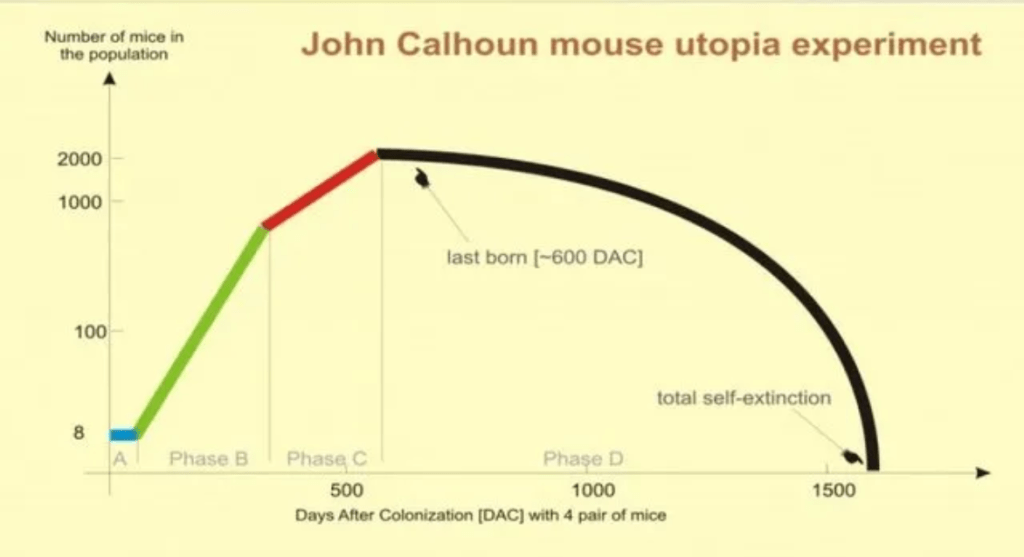
In 1968, only 3 months after Martin Luther King was assassinated for his services to human progress, 8 mice predicted how humanity would end.

They lived in a rodential paradise. Food was available whenever they required it. The temperature was balmy. There were no predators and plenty of materials to make a nest. And, perhaps most important for a young thriving mouse, there were opportunities to mouse-flirt and reproduce.

And they took the opportunity with gusto. As expected, the first year of mice paradise was booming and the population grew exponentially. After a year, there were 600 mice.

Then things changed.

After day 315, the rate of reproduction started to decline. This coincided with behaviours which were entirely unexpected, for example:

  • Parents started to abandon and injure their young.
  • Dominant males were unable to hold on to territory or mates.
  • Non-dominant males would attack each other, and make no attempt to defend themselves against attack.

Soon, the experimenters started to notice a strange cohort in the midst of the mice. They dubbed them “the beautiful ones”. These mice had clean, well-groomed fur. They didn’t have scars or wounds. Most importantly, they lived an entirely solitary existence. They ate, drank and nested alone, never socialising and never breeding. Eventually, the colony became extinct.

This experiment was seen by its instigator, a brilliant ethnologist and researcher named John B Calhoun, to be a worrying portent of things to come for humanity.

“The conclusions drawn from this experiment,” he wrote “were that when all available space is taken and all social roles filled, competition and the stresses experienced by the individuals will result in a total breakdown in complex social behaviours, ultimately resulting in the demise of the population”

His theory became known as “behavioural sink”. Its application to humans has been challenged and, in some cases, tested. Jonathan Freeman did a series of experiments with willing university students. He suggested that the issue wasn’t the density of the population, but the number of social interactions which was driving the mice nuts. He highlighted the importance of privacy, as well as community.

Another idea is one of social variety – if humans have a variety of social roles, through work or family or hobbies, then it’s possible that the plummeting of the human race into utter oblivion could be slowed or even reversed.

In any case, the study promotes more research on the impact of privacy (much to the delight of introverts everywhere) and the impact of individual purpose on society. It is possible that the meteoric rise of self-help gurus like Tony Robbins or Jordan Peterson is a sort of correction as people try to find their purpose in an ever more complicated and controlled world. The cohort of individualistic mice also inspires more questions about the concept of beauty and the importance placed on it in modern culture.

This piece is inspired by an article in Farnham Street, which provides great insight and clarity from some of the most successful people throughout history. Their podcast, The Knowledge Project, offers timeless insight and comes highly recommended. You can find a link here: https://fs.blog/

Part 3: Give me all your money – Crypto versus the State

It was snowing in Ottawa in February. A thin layer of white powder veiled the pavements and gentle flurries drifted down from the grey sheets of cloud covering the sky.

People’s breath misted as they spoke, noses reddened by the cold. In Parliament square, hundreds of truck drivers and pedestrians blockaded the streets.  The air was thick with amplified voices and blaring horns. Stark yellow police vests snaked through clusters of people, as officers of the Royal Canadian Mounted Police issued tickets and tried to disperse the protesters.

The truckers were part of a national wave of protests that hoped to disrupt the key trade routes between Canada and the USA. CBC estimated that the protest had generated losses of between $3bn and $6bn. The politics of the protests were complex and worth examining in detail. However, this piece does not take a view on the politics themselves.

6 Billion Dollars is a lot of money

In response to the protests, the Canadian government implemented emergency powers. These powers were supposedly reserved for wartime, and they enabled the police to make mass arrests and freeze bank accounts of protesters, and anyone helping to support them. The emergency powers meant that the police could do these things without a warrant, a court order or due process.

Whatever your politics, this should be a problem for both sides of the political aisle.

For right-wing and conservative thinkers, the Canadian government’s actions demonstrate a direct seizure of private property.

For left-wing and liberal thinkers, the problem comes from the general assault on the freedom of people to protest and the basic human right to access their finances.

As this situation has unfolded, it has created a wider discussion about the nature of the relationship between banks and governments. Blockchain technology and cryptocurrencies are seen by some to offer new, modern and more liberal ways to manage and secure your finances.

A protestor demonstrating the “go floppy” technique, by which they completely relax, requiring a greater number of police officers to arrest them.

So the government can just take my money?

Yes. The reason that governments have the power to unilaterally freeze bank accounts is that those accounts are held by a bank. This is a centralised organisation, which means it has a hierarchy with a chairman, a CEO, a board of directors, partners, shareholders, regulators and governments. All of them have a unilateral say in what happens to your money.

People put money into a bank to keep it safe. The caveat to this is that, when you sign up, you also agree to the bank’s terms and conditions, which allow them unprecedented control over the funds that you put in.

I don’t want people to take my money

This is where cryptocurrency can change things. Thanks to blockchain technology, there are now new forms of finance that move away from this traditional centralised model.

Decentralised financial models remove the single point of control. In these models, the community shares control, meaning that no one person can make changes to the accounts or funds that are stored there, unless there is a consensus.

Different protocols can make changes in different ways, for example in some cases, the community can vote on changes. If the majority votes yes, then changes can be made. Some of these are opt-in, and some are opt-out.

Whichever the model, the overarching concept is that your funds cannot be unilaterally frozen by despotic states or leaders with a tyrannical swagger.

Pros and cons

There are naturally pros and cons to this model which are worthy of discussion:

Cons

  • There is no protection in a decentralised model. Because of the lack of centralisation, there are no buffers, insurance or second chances if you forget your account details or if you get hacked or scammed. And it can be hacked.
  • There are avenues for dirty money. These exist in centralised formats too (just consider the recent revelations about Credit Suisse who have endured a flurry of criticism, fines and criminal cases over the last few decades with links to drug cartels and oligarchs), but they are arguably more accessible via DeFi. At the beginning of the Ukrainian-Russo war in 2022, Russia was hit with unprecedented sanctions. Overnight, there was a cryptocurrency boom. Some suggest this was due to billions of Oligarch assets moving out of the plummeting Rouble, into crypto assets, which were more stable at the time.
  • It’s complicated to use. There are no smiling bank managers and marketing approved brochures to guide you through the world of DeFi and crypto. There are however plenty of YouTube videos. But needless to say, using the tools effectively requires time and effort. The cost of making a mistake can be significant.
  • It’s soon to be regulated. For example, in the UK, HMRC is taking steps to aggressively tax crypto assets while other governments ban their use entirely. Part of the reason for this is that crypto in the form described, removes a degree of governmental power – the state cannot tax and seize assets as easily as they can when everything is centralised and highly regulated. For institutions that are used to high levels of unilateral control, financial freedom can be seen as a serious problem.

Pros

  • A decentralised model of finance brings a democratic process to changes that could impact your money. This does not happen in any real capacity in traditional banks, despite the invitations you may sometimes get to a bank’s Annual General Meeting.
  • It’s very difficult to freeze accounts in many of the truly decentralised cryptosystems without the consent of the community. This means that there is a much smaller scope for bad actors to target individuals using the system, in contrast to the way that despotic states can target individual bank accounts.
  • There are greater and fairer opportunities to profit versus traditional stock markets as, theoretically, the members of the Defi community operate on a level playing field. This is in contrast to the stock market in which current trading practices create a disproportionate advantage for specific individuals, large hedge funds and politicians. For example, there is a new trading fund that follows all the trades made by 81-year-old Congresswoman Nancy Pelosi. It’s currently tracking at over 33.69% profit this year compared to other popular funds available to the public (at the time of writing, the NASDAQ is up 1.90% and the S&P 500 is up 12.5%).

As a point of interest, the emergency powers in Canada were rescinded after 3 weeks (following the crackdown and opening back up of trade routes) . However, the financial component still remains, with the Canadian government citing that the powers to freeze assets without a court order are essential “tools” designed to “protect” people. At the time of writing, some of the bank accounts frozen under the act remain in limbo, their owners presumably relying on cash or charity to get by.

There are risks associated with trading and purchasing crypto and the information above is for entertainment only and does not constitute financial advice.

On Tolerance

Read time: 3 mins

Don’t look down. Classic advice when someone is crossing a threadbare rope bridge strung up over an abyssal crevasse. Looking down immediately inspires a stress response. Clammy hands mean you’re less likely to grip if you fall. Adrenaline fuels your panic, making a misplaced step ever more likely.

In 1974, a study by Dutton & Aron showed that a high bridge can have even more disastrous effects, and make you think you’re attracted to someone who you wouldn’t necessarily be attracted to at sea level. Why? They suggest that the panic you feel from potentially plunging to your death is misattributed to the rush of romance. It turns out there is some truth to the concept of “falling in love”.

One of the reasons that a bridge can mess with your head so much is because they are instinctively dangerous. If a bridge gets too hot or too cold, if it holds too much weight or if it gets too windy, it will collapse. And if you’re on that bridge when it does, that is a problem; and your brainstem knows it.

Locomotive #513 having an off day thanks to tolerance limits gone bad.

Tolerance

Luckily humans are quite good at reducing risk. In engineering, almost every product on the earth goes through rigorous testing to the point of failure. The outcome of this testing is a tolerance limit which dictates the point at which a piece of equipment will break beyond repair, or in the case of our bridge, collapse. This is known as engineering tolerance and is the most typical definition most people give when asked what tolerance means.

However, tolerance has a different significance when applied socially. In the context of friendship, relationships or (especially) as a parent, tolerance is a flexible concept and an essential part of human development. This can be defined as social tolerance.

Consider how good parents will shift the focus of their entire lives in order to assist the development and future of their children, putting aside passions and hobbies they used to enjoy, all for the good of their offspring; offspring that would happily shit their pants without even a moment of thought for the parent.

Best friends will tolerate frustration and pain to help each other succeed and thrive, through the horrors of hardship, addiction, grief. Long-standing couples will try to take time to listen to each other and compromise, rather than rushing in and saying something mean and hurtful, that feels good.

In each of these cases, social tolerance will take different forms. People will lean on compassion, explanation, patience and calculated pressure to ensure that relationships don’t crack and collapse. It’s an active process, designed to push previous limits for the greater good.

The fundamental difference between the tolerance limit for a bridge and tolerance among people is that the social concept of tolerance contains inherent flexibility. It requires constant assimilation and application of new information to create a new working model of the world. These models are necessary as people grow – from children to friends to parents and beyond. This flexibility allows for creativity, mistakes, novel thinking and second chances. Most of all, it promotes the possibility of progress.

Despite its virtues, this is not the model of tolerance that is widespread in society. It seems almost non-existent when people are dealing with each other. The Twittersphere, Cancel culture, censorship and IQ testing are all major symptoms of a brutal and ossified concept, of a type of tolerance made for machines and structures rather than people. These elements are more closely aligned to the weight limits on a bridge than the compassion integral to a community.

Does the social tolerance model work?

Yes. There are lots of potential scenarios where social tolerance is effective compared to a rigid, engineering-like system. There are some examples suggested below, there are no doubt many more:

  • According to the Harvard Business Review, companies who reduce staff turnover tend to be more profitable. When happy employees are asked why they stay, its typically because of things like a supportive culture. This is reversed in companies with high staff turnover. In many ways, its an example of social tolerance vs engineering tolerance.
  • Drug addicts are far more likely to recover from combined rehabilitation techniques involving family and friends than they are from arbitrary sentences and incarceration.
  • Hostage situations that engage the use of empathetic negotiation techniques have a significantly lower mortality rate than those that involving harsh deadlines supported by heavily armed response.
  • Stable attachment types in children are more likely when the parent is fair, consistent and tolerant as opposed to parenting styles which are rigid, bullying and abrasive.

So what?

People are not machines and the application of an engineering style of tolerance, one based on breaking points and limits, does not help humanity unpick the complex political and social situations that are dominating current affairs.

In fact, by reducing the scope for conversation and placing arbitrary limits on what can and cannot be said, then censoring anything that sits outside of those narrow parameters, it makes it even more likely that intolerant, authoritarian and despotic systems will emerge.

The Paradox of Tolerance is a concept devised by Karl Popper in 1948. He suggests that, in a civilised society, we should be tolerant of everything; except intolerance. When it comes to intolerance, society should work enthusiastically against it and its proponents. If we fail, the intolerant will crush those who concede and eventually overtake society for themselves. And as we’ve seen, through centuries of war and imperial conquest, humans tend to get a little bit invade-y when that happens – be it an invasion by land or an invasion of privacy.

The Berkshire Eagle, Thursday, June 24, 1948

Beyond Food

Read time: 3 mins

In October 2021, McDonald’s announced it was testing its new McPlant burger, a vegan product that was created in collaboration with Beyond Meat, a company that specialises in meat alternatives.

The McPlant is an ultra-processed patty inspired by Beyond Meat’s own recipe which uses ingredients such as pea protein, oil, extracts, colourings and stabilisers.

The McPlant adds a vegan product to a menu that is otherwise dominated by meat-based items – with a McDonald’s twist.

Why not just sell Beyond Meat burgers?

McDonald’s is one of the most successful franchises in history. Its global reach helps maintain revenues of over $6 billion. It’s famed for its efficient food processing, cheap pricing, eye-catching marketing and a string of controversies from animal welfare and health to a creative approach to tax.

Like all successful companies, one of the reasons it had reached such dizzying heights is the company’s ingenuity in maximising profits.

Typically, there are 3 ways to increase profits:

  1. Increase prices
  2. Cut Costs
  3. Find a new customer base

The new collaboration helps the chain to engage a new base that has previously been pushed to one side when it comes to the McDonalds product line. This group is comprised of vegetarians and vegans.

The challenge is one of cost. The retail price for 2 uncooked Beyond Meat burgers is set at £5 ($6.77) at the time of writing. This is more than a fully prepared McDonalds meal with a side and a drink.

So, considering the desire to engage a new base and the inability to bump prices, as well as an unwillingness to spend more than absolutely necessary on production, McDonald’s needed to find a way to keep the manufacture and distribution of this new product profitable.

What is a McPlant Burger?

The UK requires the ingredients for any food to be listed in order of weight. This gives an interesting insight into how McDonald’s have changed Beyond Meat’s recipe:

Firstly, there doesn’t seem to be a lot of plants in these plant-based burgers. There are, however, lots of extracts. The production of extracts involves a chemical or industrial process to isolate a specific flavour or element from its main component (e.g. the apple flavour from an apple). Often what is left behind and discarded is the material that provides most of a food’s nutrition.

There are also a surprising number of E numbers in each product. One of these, E461 or Methylcellulose, is a very useful additive that is also used in shampoo, toothpaste, glue and most enticingly, as a laxative.

The McPlant has quite aggressively bumped some things up the list – namely “Flavourings”, “Salt” and “Potassium Chloride”. This is unsurprising. It also seems to have shifted from the lower fat and more expensive “canola oil” to the cheaper and higher in fat “Rapeseed oil”.  

The result: a highly processed product that has volumes more salt and fat than its predecessor, making it potentially more addictive to the consumer, while simultaneously reducing the cost of production. Most importantly, a product that can be legitimately marketed as vegan and plant-based.

To infinity?

The recent partnership between one of the world’s largest fast-food chains and one of the world’s most famous providers of meat alternatives has garnered mixed reviews.

The optimists see a new age of fast food, one that is no longer dependent on the waste and suffering of animals. The cynics see another string added to the bow of the fast-food conglomerates, helping them secure more market share while “greenwashing” a notoriously un-green business model.

In either case, the result is the same.

By piggybacking Beyond Meat’s brand, reducing costs by changing the ingredients, adjusting the taste to make the product more salty, fatty and potentially addictive and all the while engaging a previously underrepresented market (vegetarians and vegans), the deal has put both companies in a great position to rake in profits.

As is so often the case, it seems the real winners are the private equity firms and celebrity investors, who can rub their hands like Mr Burns and enjoy watching their investments bloat to sweaty grotesqueness, in roughly the same manner as anyone who eats too many of these burgers.

Ancient Happiness

Happiness has become the focus for huge swathes of the population, and the quest to find it fuels an industry of gurus and self-help entrepreneurs which has grown by 20% since 2020.

Despite its most recent surge in popularity, seeking happiness is not a new endeavour. In fact, some of the most famous thinkers in history have already taken a punt.

One of the earliest was Aristotle, the Macedonian cognitive powerhouse whose work has influenced everything from maths and science to poetry and literature for thousands of years.

Happiness is an artform

Aristotle lived in a culture that believed every rational being had a purpose. This belief influenced his concept of happiness enormously.

Whereas the modern definition of happiness is often centred around the warm fuzzy feeling you get when you eat cake or hug a friend, Aristotle’s conception was different. He suggested the best definition of happiness is “Eudemonia” – literally translated as flourishing. He believed that happiness comes to people who achieve the best they possibly can in pursuit of their purpose or “universal human good”.

Spheres, excesses and deficiencies

In order to get anywhere near Aristotle’s concept of happiness, he makes it clear that one must live according to some defined moral virtues. If one can act in such a way where every action is completed according to these virtues, then one will flourish and, if followed consistently, become truly happy.

Moral virtues exist on a spectrum between an excess and a deficiency. There are lots of areas in life where one can possess an excess or a deficiency.

Each of these areas is called a sphere and they can apply to lots of different scenarios everyone encounters every day.

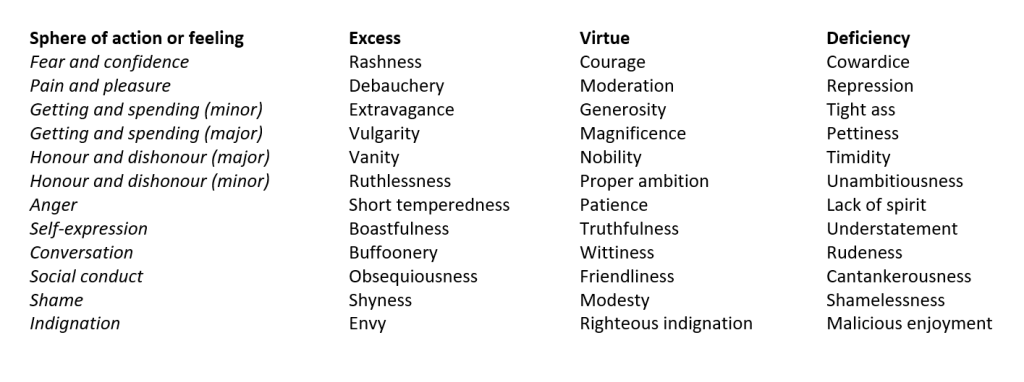
The road to a good life is simple – find the balance in each of these spheres and live and act consistently and accordingly. Below, he provides some useful examples:

On closer inspection, these seem to make sense. In the sphere of fear and confidence, too much means you can get yourself in serious trouble. You could take on things you aren’t fit for or put yourself and your loved ones in danger. Equally, a coward could create as much damage through inaction. Neither will particularly enjoy life. By Aristotle’s definition, courage is displaying confidence and accepting fear in ways that are appropriate and that will benefit others.

In terms of self-expression, someone who never finds a way to communicate their input or mindset will likely not get very far. Credit will be taken for their ideas and they will garner a reputation that doesn’t align with their skill set. This will chip away at them over time and, as with many excesses or deficiencies, eventually become a self-fulfilling prophecy. The person will likely be miserable. On the other end of the spectrum, someone who boasts about their own exploits is universally hated in civilised company – they will no doubt miss opportunities as a result of the negative feelings they induce. The virtue here is being honest about what you have done and achieved.

Virtue is a doing word

Seeking happiness through virtue is not a passive endeavour. It’s different to an innate ability like being able to see or hear. Instead, happiness is a skill that needs to be practised like a musical instrument or exercised like a muscle. People can only become virtuous by doing things. And not just anything. Learning to rock climb or down a pint in less than a minute isn’t going to cut the mustard. Instead, this theory necessarily requires you to interact with other people.

With this, our ancient Greek guru lays down some ground rules:

  1. Virtuous actors must be fully conscious.
  2. They must not have acted virtuously by accident.
  3. Virtuous acts must come from a consistent disposition and not just every now and then on a whim.

These rules mean that your everyday tyrant can’t accidentally become virtuous and fall into being happy because they forgot to murder a political rival. The psychopath cannot become virtuous by helping someone find their keys, only to con them out of their car as soon as the keys are found. It’s not clear if you can be drunk and virtuous – no theory is perfect.

Conclusion

Aristotle’s writings have lasted for 2400 years, and anything with that level of sticking power usually has something at its core that is worth considering. He is widely credited as the father of everything from logic through to natural law and his writings were the foundation of philosophy and fledgling science until the enlightenment when the scientific method became the guiding principle.

That said, the model doesn’t work for everything. There are some really important spheres that don’t quite fit the excess / deficiency model. Justice, for example, is something that’s discussed and doesn’t fit the model. You’re either unjust or just. You can’t be too just. Friendship also seems difficult to fit into the model and is arguably exceptionally important to leading a happy life. You’re either a friend and you exercise mercy, compassion and tolerance. Or you are not and you don’t.

To answer this, Aristotle suggests that a person can only be truly just or a true friend once they have mastered every other virtue. The challenge is that this seems almost impossible to attain. Nobody is perfect. Everyone has some great friends who are not necessarily virtuous all the time. Batman is obviously just, even if he is a little bit punchy in the way he delivers his justice.

Despite its shortcomings, Aristotle offers something that a lot of modern self-help doesn’t. A high concentration of modern self-help is very inward-looking. The pointy end is saturated with high functioning sociopaths whose advice is centred on becoming successful in an exclusively material sense. So much of this type of commentary is about becoming rich, famous or, if you are very lucky, an influencer. Their advice tends to centre on beating yourself into getting up at 4am, looking ripped, being confident, getting cold hard cash, being more productive than a factory conveyor belt and unflinchingly crushing anyone who gets in your way. In this sense, this self-flagellating brand of self-help sadomasochism seems to focus on excesses – things like vanity, extravagance and ruthlessness.

As effective as this approach purports to be, it has a tiny flaw in that it tends to ignore the rest of humanity. As anyone who has needed a friend can attest to, it’s astounding the impact that one person can have on the world around them.

Aristotle’s approach is impossible to enact without consideration of others and this is why, despite being older than Jesus, it still carries weight. Even now, his ethics offer wise counsel to anyone who feels that virtue, tolerance and consideration are at least as important as a new job title and a six-pack.

Aristotle’s Nicomachean Ethics is a collection of essays that are widely considered to have dominated philosophical and theological thought in the west for more than 1500 years. It was fused into Christian theology in the West and provided a basis for many modern laws. Despite its age, it still reads surprisingly well and is full of great insight and wisdom.

You can find a copy here: https://www.waterstones.com/book/the-nicomachean-ethics/aristotle/jonathan-barnes/9780140449495

Part 2: Crypto Tricks

Read time: 3 mins

Squid Game on Netflix became a cult classic overnight. It was a bloody, violent and cynical commentary on the household debt crisis that is still gripping South Korea, a phenomenon where the total amount of debt owed by individual citizens through loans, mortgages and finance is more than 100% of the country’s GDP.  

High levels of household debt is a problem. It was a significant contributor to the 2008 financial crisis. It impacts employment levels, quality of life and economic recovery – especially important when navigating the recovery from a pandemic.

From a human perspective, when times are financially difficult, there is often a surge in gambling and risky, short-term loans. For some, the allure of investing in cryptocurrency and the potential of becoming a millionaire overnight is incredibly compelling.

Squid Game Token

SQUID’s official whitepaper offered a pay-to-play, crypto-based equivalent to the Netflix game. The premise was simple. Users would purchase squid tokens. These purchases would fund a prize pot, with a small percentage going to the developers to cover future partnerships. Players would play through 6 games, as in the series, and the last one standing would win all the money.

Squid Game’s Whitepaper: https://drive.google.com/file/d/1–4MDZ-2lNmh9KpZ0TfosVHkAPCuxD6Y/view

Unlike the series, the crypto game offered uncapped rewards for players. The only limit was the number of players who joined – the more people who put money in, the greater the prize pot at the end. The other key element was that SQUID offered an “innovative anti dump mechanism” to provide users with safety and security as they played through the games in pursuit of riches.

The eloquence of the whitepaper and the confidence in their product roadmap was a clear sign. This crypto coin was going to the moon.

Green Light

Tony buying a SQUID on 28/10/21 would have paid a meagre $0.85 to own his very own SQUID token. Tony likes this and puts in $100.  What happened next is a crypto traders dream.

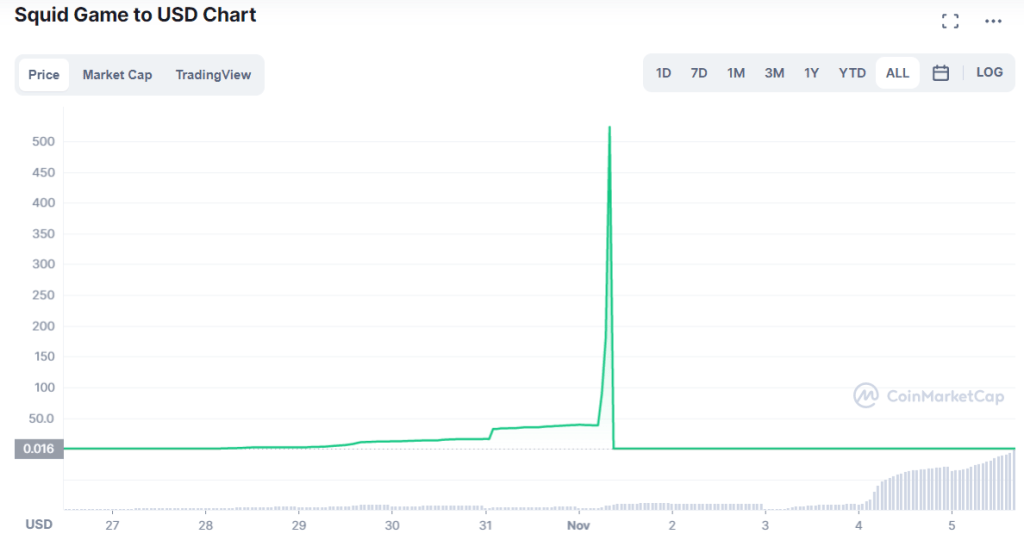
Over the next few days, the SQUID token smashed through the $1, $10 and $100 marks. By 01/11/21, a single SQUID token was worth $2,861. It made the news, being mentioned on the BBC and CNN, further driving the pump.

This meant that Tony’s $100 was worth a quarter of a million dollars. Tony is not an idiot. As any self-respecting trader would agree, when a return like that hits you in the face, it’s time to sell.

However, that’s not what happened. For millions of users who hadn’t read the small print, their efforts to sell were completely in vain. SQUID’s “innovative anti-dump mechanism” essentially meant that no one could sell their tokens. A total of $3.36 million was now locked into SQUID tokens.

What happened next, known as a “rug-pull”, was shocking. It was captured live by twitch streamer Hasanabi:

Within the space of a second, the value of SQUID dropped completely, from over $2.8K to $0.003. The creators of the project had changed the code, allowing them to sell all of their reserves in one go. They walked away with close to $3.36m in the end. And Tony was left with nothing.

The graph showing the significant pump of the Squid Game token and it’s drastic dump soon after

Red Light

On closer inspection, it should have been no surprise that this was a scam. The whitepaper is 17 pages long and is fairly clear about the outcome for users who invest in SQUID. “Your experience will only reflect on the… sorrow of losing money when the game failed [sic]” it states.

Their innovative anti-dumping mechanism, it explains, requires users to purchase “$Marbles”. These were a pay to play elements that were significantly more expensive than the SQUID token itself. “$Marbles” were required in order to be able to free trade SQUID – the implication being that those without “$Marbles” would not be able to trade freely and realise their returns.

Their roadmap is impressive in its audacity, seeking to launch all 6 games, release the token to all top crypto exchanges and start a “powerful marketing campaign” in 60 days. Anyone who has been near an IT project knows that this is insane.

The roadmap released as part of the Squid Game whitepaper.

Basic Tenants

Naturally, there are risks associated with the entire crypto market. Not only is there the volatility to consider, but there are some commentators who liken the excitement to the dot-com bubble in the 90s. Similarly, they suggest that the whole market could see a similar trajectory. The other thing to consider is where the utility of blockchain technology will settle. Entire segments of the market could disappear as different uses evolve or become more regulated.

That said, there is still a lot of potential in this nascent industry. With some common sense and some insight, it is possible to realise great returns.

Here are some key tips that can help when exploring new crypto coins:

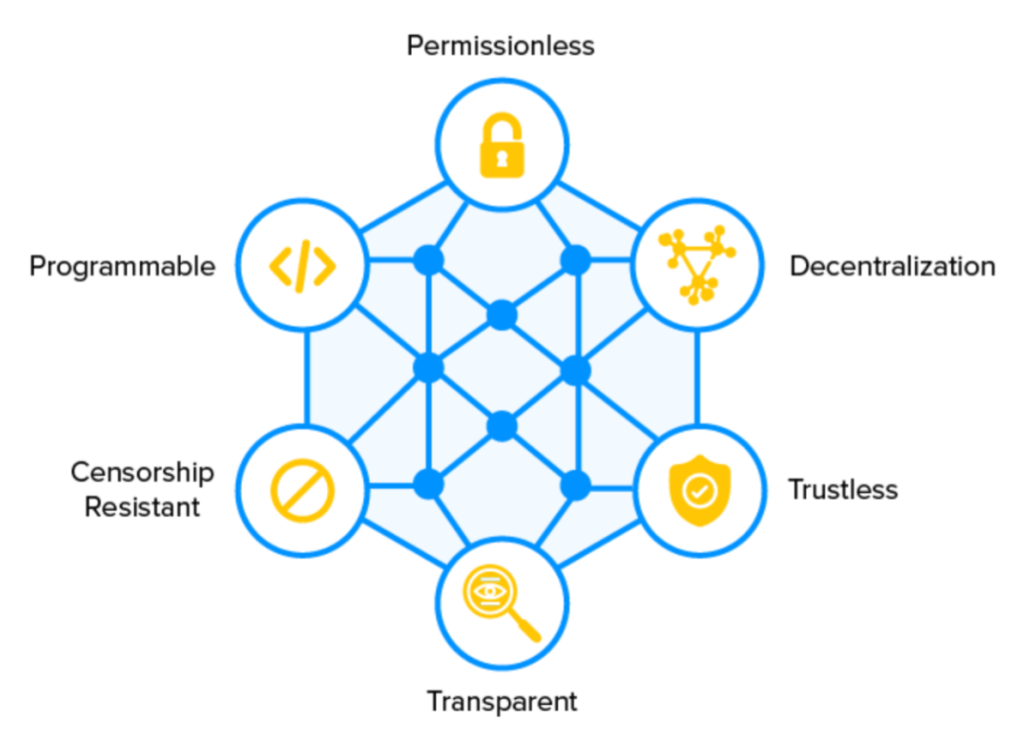
  1. Be wary of the Binance SmartChain: it’s incredibly easy to create a token on this chain. SQUID ran on this chain. It provides a very low barrier for entry where anyone can anonymously create their own token in a matter of hours. It’s worth looking for coins that are part of their own large and transparent ecosystem, with thriving communities and a proven track record of development. Coins such as DOT and LUNA fit this model.
  2. Avoid coins based on pop culture or zeitgeist: there will always be products that are developed to piggyback on hype. At best, they will be built in basic technology that doesn’t offer much in terms of differentiation. At worst, like SQUID, they will be outright scams. That said, there have been some great gains from these types of tokens. FC Barcelona released their own tokens which soared in price before dumping. However, the real value of crypto lies in the technology itself and the technology stack developed behind it.
  3. Check the quality of the documentation: the quality of the documentation and content is important. A cursory glance at the SQUID whitepaper should have sent everyone running for the hills. In many cases, developers will have a community site such as a Discord. This will give an idea of the cadence and frequency of development. These tools should provide some great insight into the development curve and health of any given crypto asset.
  4. Finally, and most importantly, only invest what you are prepared to lose.

This is part 2 of a series looking at the rise of crypto currency technology for beginners.

Madrid

Read time: 1 min

Madrid is different from other cities. In the grey drizzle of London, the sounds are often rushed and raucous. Car horns bark at wayward pedestrians. Deafening sirens blaze through the streets, as police cars and ambulances tear by, casting the brutalist concrete in brief and cold blue light. The irritation of people rushing up behind you is almost palpable. You can almost see it escaping through their nostrils like boiling water, the steam fuelling their huffing as they hurry their lives away.

Madrid is different. People meander through side roads like little rivers of humanity. They flow into lush green spaces like the Parque del Buen Retiro, where magicians delight with showmanship and friends come together to play drums, beating a ventricular rhythm. Or, the Parque de la Montana, where lone Spanish guitarists serenade Madrid’s rolling skyline in front of the Temple Debod, an ancient structure that has outlived pharaohs and emperors alike.

The Temple Debod – Paulo Fontes/Getty Images

There is a melody to the inner city too. The bushes and trees chirrup with hundreds of starlings (which are not nearly as endearing as the chirrup of the pedestrian crossings). Most compelling for someone from England, in December, the sun marinades the streets and parks with a warm winter glow, reflecting off hundred-year-old architecture and casting shadows through the peculiar side streets. It’s a unique cacophony. 

It’s fitting then that Madrid is home to such incredible performers. These people play with movement, sound, and light in ways that are completely congruent with the context of their city.

The great thing about the performing arts is that they are irreverent in the face of language. The practiced elegance of a dancer can tell a story of passion and playfulness without uttering a word. Fire has been part of humanity for millennia. Watching the focussed grace of a fire dancer as their movement illuminates unknown darkness. It’s comforting to know this is a spectacle that has no doubt mesmerized generations from the cradle of civilization to Clacton-On-Sea. The longing and pain felt in heart-catching harmonies captivate because of the sound as much as the words.

It’s easy to forget that behind these polished smiles sits decades of intense training and hard work. The fact is that, regardless of how tired, grumpy or shit their day has been, the show must go on. It sounds grueling to dance and sing in front of hungry crowds day after day. But when you ask any member of this cadre if they would swap it for a 9 – 5, the answer is always no. And if you ask why, it is surely some variation of “well, I love it”.

This love of their craft is part of the reason that anyone is welcome, regardless of language or disposition. It’s a lesson from the heart of Madrid and one that should be the city’s main investment and its main export.

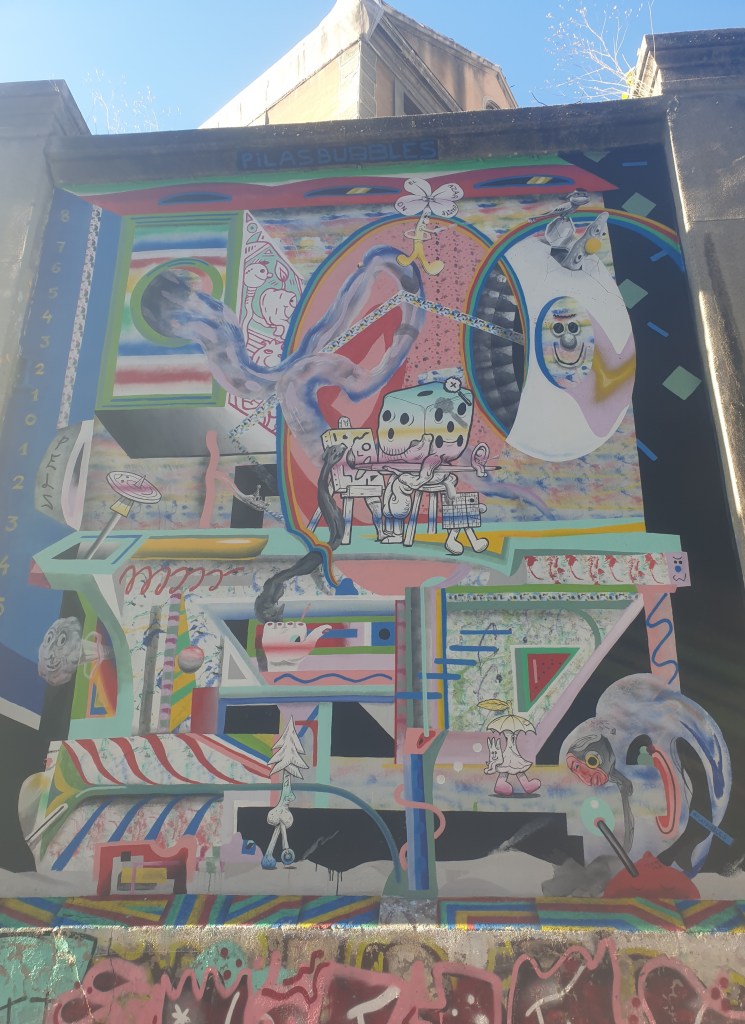
One of 25 unique pieces of wall art on the walls which surround the “Tabacalera” which used to be an old tobacco factory. The walls are redecorated once a year. This raunchy little number is by Pilas Bubbles.

The district of Chueca in Madrid is a beacon of tolerance and diversity. Fluidescape is a fantastic exploration of sound and sight with performances throughout the week – you can visit at Calle de Gravina, 13, Madrid, Spain, 28004

Trust Shifts

Read time: 3 mins

Trust is a confident relationship with the unknown. From the moment we became conscious, humans have navigated the world through an ever more complex series of risk assessments. Should I try this new thing or go this new way? Should I hire this person or buy this product. Which loan should I take, which stock will give me the greatest return?

The problem is the world is incredibly complex. To complete a full risk assessment before taking any decision would be at best prohibitive and at worst incapacitating.

So, to help us move through the world more easily, we often seek shortcuts to help us navigate the unknown. This is especially prevalent when dealing with other people. Over time, the nature of these shortcuts has changed based on our circumstances.

In her book “Who Can You Trust?”, Rachel Botsman defines several cultural trust shifts. They point to changes in the shortcuts we use to navigate the unknown and the strangers around us. And, she continues, they help to explain why so much of the world right now seems chaotic and scary.

Local trust

Local trust lasted a long time. A really long time. In fact, most of human civilization has used this shortcut to help create and maintain trust relationships with other people.

When human habitats were about the size of small market towns, trust tended to be based on who one knew in the community. You would tend to see the same people every day. You’d buy your bread from Egbert. You’d borrow some money from Edmund. And if you didn’t pay for the bread or pay your loan back, everyone would know that you were an unsavory character. People wouldn’t do business with you and you would rapidly lose the protection of the community. This was a big deal and could quite literally be a matter of life or death.

Local trust was core to these tribes and towns all the way through to the late 18th century.

Features of local trust

  • Subjective
  • Open
  • Small scale
  • Isolated
  • Non-hierarchical

As small market towns grew, they became more productive. In time they became more profitable too and people started to form companies. Eventually, it was impossible to avoid interacting and trading with strangers.

The problem was that local trust couldn’t really help you work out if someone new was trustworthy or not. There was no gossip about them. They’d not done business with anyone you knew. They had no reputation to tap into. They might even be working for someone else, someone who you had never and would never meet. This was a risk. So, humans developed our first major trust shift – institutional trust.

Institutional trust

The Honourable East India Company was formed in 1600 to trade in the Indian ocean and later with China. Soon it seized swathes of the Indian subcontinent, part of South East Asia (including Hong Kong), and had posts in the Persian Gulf. By the mid-1700s its main exports were cotton, silk, saltpeter, and tea. They turned over the modern equivalent of close to $1 billion and, like all conglomerates, showed their dark side through trade in slaves and opium.

The logo of the East India Company (EIC) – one of the earliest international brands. EIC had its own navy and standing army. Before the age of spin doctors, their brand would be as likely to inspire fear as much as any other emotion.

With the arrival of companies like the East India Company and those like it (such as the Dutch Vereenigde Oost Indische Compagnie or V.O.C), humans stopped interacting with local markets as much and started to interact with huge and faceless corporations.

These brands had no concept of the individual which meant that people had to find new ways of forming trust relationships.

To do this, people had to make a trust shift. Rather than the reputation of an individual, people started to rely on black-box processes – things like contracts, insurance, and regulation – to ensure that their relationship with the unknown, in the hands of these faceless brands, could be trusted. In return, they would give these institutions incredible amounts of power to decide who was allowed to do what and how things could work (consider the hoops one needs to jump through to buy a house or get a loan).

This model formed the basis of our trust for another 300 years. The black-box processes became ever more convoluted, requiring ever expanding armies of technical consultants and experts to navigate. This form of trust served to lay the foundation for most of the economy and by extension all of the largest brands that have come to dominate the world today.

Features of institutional trust

  • Opaque
  • Closed
  • Centralised
  • Permission based (computer says no)
  • Top down

Distributed trust

In the same way that local trust wasn’t designed for big cities and bigger businesses, institutional trust was not designed for the digital age. Technology meant people could pry open the inner workings of these black-box processes and see what was going on inside. Often, they didn’t like what they saw. Meanwhile, these large companies were able to utilize technology for greater and greater profit in more insidious ways.

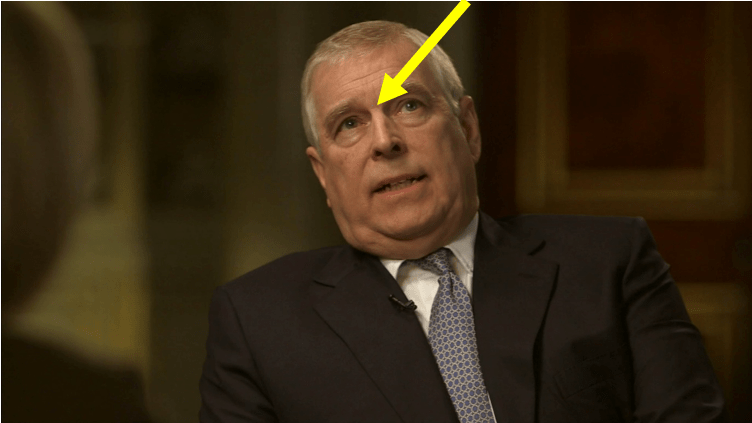
These two elements working in tandem have led to a dramatic decrease in the trust placed in our institutions. There have been huge breaches. Things like Cambridge Analytica, the horsemeat scandal, all of Facebook and Prince Andrew existing.

A still from Prince Andrew’s interview. The arrow references where sweat should be but isn’t.

At the same time, technology has enabled us to simplify the way we mere mortals judge big conglomerates because we can share opinions and reviews incredibly quickly. These are powerful. Good reviews, from eBay to Silk Road and Deliveroo to Airbnb, are now so critical that bad actors will pay serious money to have them fabricated just to boost their reputation (and in turn, their profit).

The mirror can be turned the other way, with companies like Uber and UpCounsel (Fiverr for Lawyers) rating you, the user, for your interactions and quality. The implications of a bad review mean you can be denied access to top-tier services.

The result is that trust has begun once again to sit outside institutions, in the apps on our smartphones and in the content of online reviews. Reputation no longer comes from your standing in a small community or the power of your brand, but rather the amalgamation of hundreds and thousands of data points, often from a wide range of demographics and cultures. This is known as distributed trust.

Features of distributed trust

  • Transparent
  • Inclusive
  • Networked
  • Accountability
  • Bottom Up

The challenge

As technology becomes more sophisticated, some people see a slippery slope emerging. On the one hand, the big companies’ evidenced disregard for human and societal well-being is endemic.

Democracy and social cohesion seem to be under constant attack. Individuals are constantly bombarded with adverts and psychological tricks that are designed to leverage this new form of trust and generate ever more profit. Individual’s actions are now under a microscope more than ever before and it’s conceivable to imagine a big brother / Black Mirror type future where every interaction is rated and you end up with a social credit score that dictates your access to goods and services.

Black Mirror’s 3rd series depicts a world where everyone is judged by their every interaction; from a distracted moment with a barista to a downward inflection of your smile in the lift. Perhaps one of the more interesting elements is the huge array of management consultancy firms that exist in this parallel world, there to help bump people’s ratings. For a fee of course.

On the other hand, this most recent trust shift can lead to progressive and positive places. In this scenario, these trust systems are utilitarian. The technology promotes and supports trust relationships in a way that doesn’t require a constant and invasive system of surveillance. This route would mean the technology could augment and strengthen the types of things that local trust helped foster in the past – community and shared responsibility. For this route to simply emerge, let alone flourish, there needs to be a greater focus on trust-based incentives for individuals and companies alike.

Rachel Botsman is an expert in trust and technology and what this means for life, work, and how we do business. She’s a graduate and first-ever Trust Fellow of University and is a speaker well worth watching via her many talks online. A link for her book, Who Can You Trust? be found here: https://www.amazon.co.uk/Who-Can-You-Trust-Technology/dp/1541773675