What Happened to FTX?

Two friends were walking into Town with a barrel of wine. The road was dusty, their walk surrounded by bright fields of yellow flowers. It was mid-July and the sun was warming their backs. “I reckon we could make a decent amount from this you know” said one, patting the side of the barrel. The other grunted in agreement, sweat beading at his temples around the brim of his hat. Halfway through their journey, they came to a tree. It overhung a small, enticing patch of shade. As they flopped down, one felt a coin in their pocket. “Hey, I’m thirsty. If I give you this coin, can I have a cup of wine” The other looked over and nodded, taking the coin and putting in his pocket. Soon, he himself became thirsty. He said “Could I buy a cup of wine off you with this coin?” The other agreed. This continued until they drunk the whole barrel dry.

So what does this have to do with what happened to FTX?

Two men sitting under a tree drinking from a barrel in the style of Monet. This is the result, courtesy of Dallee-2, an incredible AI text to art program.
Two men sitting under a tree drinking from a barrel in the style of Monet. This is the result, courtesy of Dallee-2, an incredible text to image AI program.

The Dream

FTX was one of the biggest trading platforms for Cryptocurrencies. It offered streamlined services to purchase different types of crypto with cold hard cash. You had access to data to help you trade and a wallet to store your funds. The company was valued at $33 billion dollars. Its investors included some huge funds, big names like Sequoia and Softbank. And in November 2022, they filed for bankruptcy.

The first domino fell after a report was leaked on the digital currency news specialist CoinDesk. The report was damning. It suggested that FTX was taking the fiat (or normal) currency that users put in to buy their new cryptocurrency tokens, and then they were using those normal funds to invest in assets. This is normal, banks do this. However, the report suggested that behind the scenes, FTX was not backing the funds that users were pouring in on a 1:1 basis. Moreover, the assets that FTX was investing were not liquid, meaning that users wouldn’t be able to get their money out if there was a “run on the bank” (that is to say, if everyone tried to get their money out all at once).

The Reality

This is a problem for normal banks too. In 2019, there was a liquidity crisis in Lebanon. The country was floundering, unable to secure foreign investment. This lead to a widespread fear that the country would not be able to pay its debts, which were rapidly maturing. The value of the Lebanese Pound (£L) developed its own black market value, divergent from the official exchange rate. The inflation was incredible.

Over the course of a few years, the black market value of $1 in Lebanese Pound increased from £L1,600 to over £L15,000. To make matters worse, the Lebanese central bank printed 266% more bills from 2019. It was a disaster and in October 2019, there were huge protests. In response, the banks closed their doors and banned people from accessing their savings for an unprecedented 2 weeks. When they opened, they only allowed customers to take money out in the local currency (rather than in dollars), to widespread anger and desperation. To this day, the country is in shock, with enforced blackouts and shortages of vital medicines. In September 2022, the banks closed again for 3 days as depositors raided them to try and access their money.

Protestors in Lebanon in 2019.

The Nightmare

So this sort of problem is not unprecedented in the financial world. However, this is where things start to become more sinister. To understand what happened to FTX, it’s important to look at who owned it. Sam Bankman-Fried is a crypto golden boy and was the brains (and founder) of both FTX and another company, called Alameda Research. Alameda Research was an investment firm that specialised in crypto assets. The document released by CoinDesk suggested that Alameda Research held a large amount of the FTT token (which was FTX’s own cryptocurrency). Moreover, Alameda owned a large portion of FTX itself. This made the assets illiquid (and very much against the rules in any normal financial services operation).

Alameda was borrowing millions of dollars from FTX, using it’s FTT reserves (FTX’s own cryptocurrency) as collateral. The problem was this was pointless due to the relationship between Alameda and FTX. Soon it was rumoured that FTX has begun using user funds to loan out to Alameda.

On hearing the rumours, Changpeng Zhao (or CZ as he’s known), the CEO of FTX’s main competitor Binance, said they would be winding down their position in FTT over a few months. This lead to a “run on the bank” as consumers tried to get their money out before the price completely crashed. But due to the structure set up by FTX and Alameda, they couldn’t. Binance soon issued a letter of intent to purchase FTX. After 24 hours (and some no doubt illuminating due diligence) Binance ran for the hills, stating that the issues they had found were “beyond Binance’s help or ability to control”.
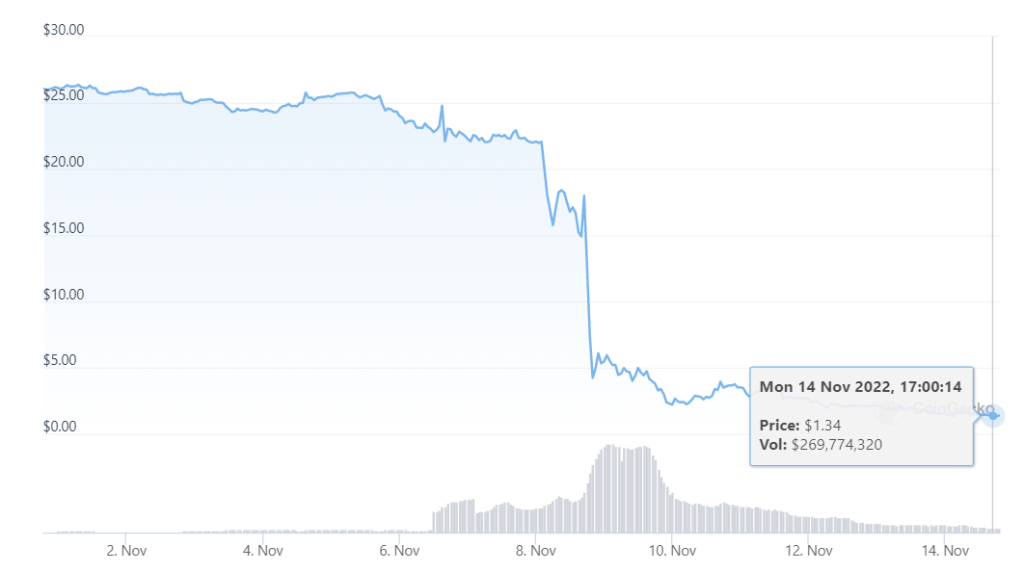
FTT’s graph showing the moment people realised it was going up in flames

The Reverie

Needless to say, if you had money stored in FTX’s secure wallet when it went down, it was game over. There was nothing to back it up. There was no insurance. It was gone.

If what happened to FTX sounds like a pyramid scheme, it’s because it probably is. It is under the microscope of authorities across the world. Lots of people lost a lot of money. The mastermind behind FTX and Alameda Research, Sam Bankman-Fried, lost $15 billion off his net worth overnight. Bitcoin dropped to its lowest price in 2 years. The leaders of other exchanges are queuing up to beg and promise an already battered and bruised base that they’ve never had their hands in the cookie jar.

The first problem is that the system is set up to make it easy for this kind of thing to happen. These companies don’t have to report their sales in the same way you do with normal currency. This makes it easy to dump coins onto unsuspecting retail investors. Because of the scale of the opportunity, there is more incentive for these organisation to take massive risks – because ultimately the real risk is passed off to the retail investor as the bottom of the pile.

The second problem is that users are committing vast amounts of money into a trust-less ecosystem. It’s not regulated or insured. It’s main players are spread out throughout the world, across multiple jurisdictions. That said, it is very likely that regulators (in the US at least) will be paying very close attention to FTX to see if they mismanaged funds. And the chances are that they have. It’s a scandal akin to the mortgage backed securities problem that caused the 2008 global financial crash. The difference here is twofold. Firstly the crypto market is not big enough (anymore) to cause worldwide problems. Secondly, unlike the big banks and hulking financial institutions, which were directly responsible for the 2008 global crash, some of these people might actually go to jail.

The battle of the regulators: the US regulators are battling it out to see who’s best to regulate the crypto market – will it be the SEC? Or, with an even more charming acronym, will it be the CFTC? Only time will tell.

Most of this summary and analysis is paraphrased from Pivot, a podcast from Vox Media. The podcast is an essential and balanced voice in the world of tech and politics. It’s presenters, Scott Galloway and Kara Swisher, offer insight and wisdom on a range of topics. And, to make things even better, they do so with charm, compassion and good humour. You can listen to the podcast here: https://podcasts.voxmedia.com/show/pivot

For more Smarticles on the savage and brutal world of crypto tricks, read about the Squid Game Token here: https://smarticlesdotcom.wordpress.com/2022/01/15/part-2-crypto-tricks/


Would you…um?

In 1998, a Jazz group called Touch & Go composed an earworm that shot to number 3 in the UK charts. Its saxophone riff is iconic – the link is below if you’d like a quick boogie:

One of the most distinctive aspects of this song is the sample. A dulcet female voice simply  says:

  • I’ve noticed you around
  • I find you very attractive
  • Would you go to bed with me?

The song was very popular. It was used in mobile phone and beer adverts and became especially popular in Eastern Europe. But there is more to this sample than simply seduction.

Men are from Mars

The 1970s and 1980s were a time when psychology was desperately trying to get a foothold. It had moved from the abstract dream theories of the psychoanalysts (like Freud and Carl Jung), through the robotic theories of the behaviourists (such as Pavlov and B. F. Skinner) to a more enlightened and humanistic age that was interested in trying to explain our relationships with more than deep subconscious desires or superficial conditioning.

At the time, the general consensus was that men were more open to encounters of a sexual nature than women. Two experimenters, Russell Clark and Elaine Hatfield wanted to find out. They devised an experiment to test the theory.*

“Slightly unattractive”** confederates (the name for people who play along in psychological research) were sent out on College Campuses to ask random strangers a question. They would start by saying:

“I have been noticing you around campus, I find you very attractive”

Then they would ask one of 3 questions:

  1. Would you go on a date with me tonight?
  2. Would you come over to my apartment tonight?
  3. Would you go to bed with me tonight?

The experiment was done with a female confederate and a male confederate to 48 individuals each across 2 experiments, 4 years apart.

*It’s worth noting that these experiments were conducted while same-sex relationships were still criminal in most of the USA (with a number of states only decriminalising same-sex relationships as late as 2003). As a result, there is a conspicuous lack of data on LGBTQ+ preferences.

** A brutal but verbatim quote from the research. The confederates were asked to rate each other. Those who rated an average of 7.5 / 10 attractive on a subjective scale were asked to participate.

Women are from Venus

The results were emphatic and did not change dramatically between the experiments in 1978 and 1982. Below is an aggregate score.

Results from both the 1978 and 1982 experiments.

What this shows is that the men in this experiment were 22% more likely to say yes to bedding someone than going on a date (although it’s worth noting that a number of these date rejections were due to existing relationships, prior commitments or diary clashes. It’s also worth noting that the same relationships, prior commitments and diary clashes didn’t seem to dissuade the “would you got to bed with me tonight” group anywhere near as much). Men’s propensity to go to bed with the female confederate increased from 1978 to 1982 by a small margin.

There are many differing explanations for why this could be the case. On the one hand, researchers point to evolutionary potentialities for why women were more selective. This side of the argument suggests there is more cost for women who make a mistake in partner selection. In the most basic sense, there’s the physical cost that women go through when they get pregnant and carry a child to term. There is also the risk of meeting a bad partner with abusive intent. As a result, this theory goes, women are evolutionarily pickier. The other side of this debate focuses on the roles traditionally assigned in society. It was not too long ago that gents were lauded in men’s clubs throughout the world for their promiscuity, while ladies were encouraged to save themselves. As a result, the societal pressures on the participants influenced their responses and make them more traditional such that they adhered to their assigned roles.

But everybody poops

Despite the differences seen in these responses, further research has shown that whatever we think about ourselves, everyone who experiences arousal to the things they are attracted to, does it in more or less the same way. Throughout the 1970s and 1980s, multiple experiments (using some disturbingly named equipment – see page 43 of Clark and Hatfield’s paper below for more details) found that, despite their self-report answers when interviewed (which showed a lot of people deny they were aroused at all when asked), physiologically, everyone is aroused to more or less the same extent when faced with their preferred scenes of a sexual nature.

It would be interesting to repeat these experiments now. The introduction and subsequent pillaging of the sex and dating scene, from apps like Tinder or new adult sites such as OnlyFans, have changed a lot of people’s views about the traditions surrounding sex. This technology promotes casual, voyeuristic, non-lasting relationships. While marketed as liberating and progressive, it’s also true that they are built to maximise profit, so promoting this type of relationship supports their business models and, by extension, their bottom lines.

That said, if the differences were due to evolutionary psychology then it is unlikely there would be significant differences in the results today, even with the normalisation of casual encounters and new technology that’s cropped up since the 1980s. If the responses of participants were due to societal pressure, however, then it’s likely we would see more equilibrium in the results as time goes on. The other fascinating element would be to see how the modern understanding of gender and identity would impact the results if a similar experiment was conducted today, now that people can express themselves and their sexuality more freely, without fear of prison or hard labour (in the U.S.A at least).

Elaine Hatfield is an incredible researcher who has had a great career and has published a huge number of books in the field of human relationships. In 1975 she even had a grant worth $84K taken away from her due to annoying a senator who felt that exploring human relationships was a waste of public money. Her Passionate Love Scale, which tries to measure how in love one can be, is still widely used today. Russell D Clark was a researcher at the University of Kansas. He died in 2011.

The paper: http://www2.hawaii.edu/~elaineh/79.pdf

The Passionate Love Scale: http://www.elainehatfield.com/uploads/3/4/5/2/34523593/passionate_love.pdf

Would you…um?

In 1998, a Jazz group called Touch & Go composed an earworm that shot to number 3 in the UK charts. Its saxophone riff is iconic – the link is below if you’d like a quick boogie:

One of the most distinctive aspects of this song is the sample. A dulcet female voice simply  says:

  • I’ve noticed you around
  • I find you very attractive
  • Would you go to bed with me?

The song was very popular. It was used in mobile phone and beer adverts and became especially popular in Eastern Europe. But there is more to this sample than simply seduction.

Men are from Mars

The 1970s and 1980s were a time when psychology was desperately trying to get a foothold. It had moved from the abstract dream theories of the psychoanalysts (like Freud and Carl Jung), through the robotic theories of the behaviourists (such as Pavlov and B. F. Skinner) to a more enlightened and humanistic age that was interested in trying to explain our relationships with more than deep subconscious desires or superficial conditioning.

At the time, the general consensus was that men were more open to encounters of a sexual nature than women. Two experimenters, Russell Clark and Elaine Hatfield wanted to find out. They devised an experiment to test the theory.*

“Slightly unattractive”** confederates (the name for people who play along in psychological research) were sent out on College Campuses to ask random strangers a question. They would start by saying:

“I have been noticing you around campus, I find you very attractive”

Then they would ask one of 3 questions:

  1. Would you go on a date with me tonight?
  2. Would you come over to my apartment tonight?
  3. Would you go to bed with me tonight?

The experiment was done with a female confederate and a male confederate to 48 individuals each across 2 experiments, 4 years apart.

*It’s worth noting that these experiments were conducted while same-sex relationships were still criminal in most of the USA (with a number of states only decriminalising same-sex relationships as late as 2003). As a result, there is a conspicuous lack of data on LGBTQ+ preferences.

** A brutal but verbatim quote from the research. The confederates were asked to rate each other. Those who rated an average of 7.5 / 10 attractive on a subjective scale were asked to participate.

Women are from Venus

The results were emphatic and did not change dramatically between the experiments in 1978 and 1982. Below is an aggregate score.

Results from both the 1978 and 1982 experiments.

What this shows is that the men in this experiment were 22% more likely to say yes to bedding someone than going on a date (although it’s worth noting that a number of these date rejections were due to existing relationships, prior commitments or diary clashes. It’s also worth noting that the same relationships, prior commitments and diary clashes didn’t seem to dissuade the “would you got to bed with me tonight” group anywhere near as much). Men’s propensity to go to bed with the female confederate increased from 1978 to 1982 by a small margin.

There are many differing explanations for why this could be the case. On the one hand, researchers point to evolutionary potentialities for why women were more selective. This side of the argument suggests there is more cost for women who make a mistake in partner selection. In the most basic sense, there’s the physical cost that women go through when they get pregnant and carry a child to term. There is also the risk of meeting a bad partner with abusive intent. As a result, this theory goes, women are evolutionarily pickier. The other side of this debate focuses on the roles traditionally assigned in society. It was not too long ago that gents were lauded in men’s clubs throughout the world for their promiscuity, while ladies were encouraged to save themselves. As a result, the societal pressures on the participants influenced their responses and make them more traditional such that they adhered to their assigned roles.

But everybody poops

Despite the differences seen in these responses, further research has shown that whatever we think about ourselves, everyone who experiences arousal to the things they are attracted to, does it in more or less the same way. Throughout the 1970s and 1980s, multiple experiments (using some disturbingly named equipment – see page 43 of Clark and Hatfield’s paper below for more details) found that, despite their self-report answers when interviewed (which showed a lot of people deny they were aroused at all when asked), physiologically, everyone is aroused to more or less the same extent when faced with their preferred scenes of a sexual nature.

It would be interesting to repeat these experiments now. The introduction and subsequent pillaging of the sex and dating scene, from apps like Tinder or new adult sites such as OnlyFans, have changed a lot of people’s views about the traditions surrounding sex. This technology promotes casual, voyeuristic, non-lasting relationships. While marketed as liberating and progressive, it’s also true that they are built to maximise profit, so promoting this type of relationship supports their business models and, by extension, their bottom lines.

That said, if the differences were due to evolutionary psychology then it is unlikely there would be significant differences in the results today, even with the normalisation of casual encounters and new technology that’s cropped up since the 1980s. If the responses of participants were due to societal pressure, however, then it’s likely we would see more equilibrium in the results as time goes on. The other fascinating element would be to see how the modern understanding of gender and identity would impact the results if a similar experiment was conducted today, now that people can express themselves and their sexuality more freely, without fear of prison or hard labour (in the U.S.A at least).

Elaine Hatfield is an incredible researcher who has had a great career and has published a huge number of books in the field of human relationships. In 1975 she even had a grant worth $84K taken away from her due to annoying a senator who felt that exploring human relationships was a waste of public money. Her Passionate Love Scale, which tries to measure how in love one can be, is still widely used today. Russell D Clark was a researcher at the University of Kansas. He died in 2011.

The paper: http://www2.hawaii.edu/~elaineh/79.pdf

The Passionate Love Scale: http://www.elainehatfield.com/uploads/3/4/5/2/34523593/passionate_love.pdf

Smarticles Business: Payroll Evolution, not Revolution

In 2007, Steve Jobs jumped up on stage to unveil something that people in the 1980s thought was utterly impossible. He was dressed in his iconic turtle neck, with dad-style sneakers and baggy jeans. His pale pallor was a stark contrast to the black curtain at the back of the stage. Soon he was dwarfed by the images on the screen behind him as well as the immensity of what these images would come to represent.

Over the next 2 hours, he proceeded to revolutionize the most fundamental part of human interaction – how we communicate. The iPhone was born and the world; from shopping to driving, and music to the internet, would never be the same again. But what does this have to do with the future of payroll?

Since this moment, technology providers from every corner of the industry have sought to have their own iPhone moment. Their collateral and sales pitches talk endlessly about being at the cutting edge, all vying for their own revolution in their particular sector.

One sector however has seemed resistant to this type of change.

Paying people for their work is an idea nearly as old as humanity. It’s true that the form, etiquette and currency have changed dramatically- from livestock to shells to precious metals to modern fiat and cryptocurrencies.

However, the fundamentals – the ground rules – have been doggedly consistent – people want to be paid on time and correctly or else they get pretty peeved. This means that payroll professionals are naturally sceptical when it comes to people talking about a “revolution” of the way payroll is done. If it goes wrong, at best people will be deeply unhappy. At worst, it can end a company.

So what does this mean for technology providers who want to bring the weight of 2022 technology to bear to help payroll professionals? One suggestion is to look at Payroll through the lens of evolution not revolution.

Looking at the fundamentals

Quite often, when talking about the future of a payroll solution in a business, software vendors will talk about giving more time back to staff. Staff can spend this time on strategic vision, they say, and operational objectives. They can add value to the company in other ways.

While this is good for a lot of departments, it often overlooks two things about payroll professionals:

  1. The job is all about attention to detail which doesn’t have shortcuts.
  2. A lot of payroll professionals enjoy number crunching and the problem-solving that comes as part of payroll.

So with that in mind, how can technology providers help payroll professionals in a way that would actually be valuable to them? Below are some suggestions from Max van der Klis-Busink, the Global Head of Payroll at Zoom.

  1. Put yourself in payroll’s shoes

How can technology be developed to make the life of payroll professionals easier? Around 60% of the job is data crunching, much of which is simple but manual and labour intensive.

For example, if I want to see the average pay for a particular pay bracket over the last 5 years then this should be an easy task. Except it’s not. Because most of the time it involves pulling previous separate years into a big spreadsheet. It means picking out lots of different data points that could skew the information – leavers, anomalies, bonuses etc.

Future payroll solutions should allow payroll professionals to pull out and manipulate data far more easily such that there is more time for the actual analysis and detail of the data, rather than simply building the data into a structure that makes any kind of sense. If technology could do this for payroll professionals, it would be seen as a massive win by a large number of companies.

  • Move away from the idea of connectors and interfaces and toward common data

In the human capital management world, the idea of revolution is everywhere – and rightly so. A company’s biggest expenditure is always its staff. And in a world where people’s relationship with work is changing dramatically, it makes sense that their technology should revolutionize along with the relationship with staff.

However, something that happens all too often is that during the flurry of revolutionary ideas and concepts washing over the HR technology, Payroll is forgotten. This usually leads to a world where the data models for HR can be drastically different to the data that is essential to payroll.

The result – more work for payroll professionals. They now have to try and adapt the new data from cutting-edge HR systems to fit into a payroll structure that has remained largely unchanged for the last 50 years.

So, how can technology vendors help? By building better collaboration between human capital management systems and payroll systems. Simply this means that the systems should share commonalities – things like better validation and flow.

This will improve the quality of life for payroll professionals by a significant margin so they can spend more time on the actual numbers. One way to help is to ensure that Payroll is kept in the loop when big HCM changes are afoot. Including Payroll in the conversation will be invaluable in ensuring that payroll evolves and enjoys the same benefits from technology as other departments.

  • Educating employees

Payroll is time sensitive by its nature. Deadlines are strict and unmoving. Missing them is not an option. And alongside all of this time pressure, payroll must be completely compliant and correct to the decimal place. So what is the worst thing that can happen in a payroll run? Having to call up your provider to ask a question or get some historical pay slips.

This will not change as payroll professionals enter the future, so developing software that is simple and intuitive enough that payroll professionals, or even employees themselves, can self-serve should be a fundamental focus for payroll software. The ability for an employee to download their payslips themselves, or view them on a mobile app. The ability for payroll professionals to pull up valuable data quickly and in any form they want, without having to export raw data and hand crank everything. This sort of enablement should be the focus for payroll software, beyond developing a shiny new toy that may need years of testing before the sector has the confidence to test it, let alone fully adopt it.

The reason is simple – the more time that payroll professionals spent logging requests with payroll software vendors or answering requests for employees, the less time they have to get into the detail, ensure everything is correct and people are being paid on time and correctly for the valuable work they do every day.

So, payroll is one of the most important things that a company needs to get right. Because of its traditional nature, it is also one of the hardest places to leverage technology in a way that will make a real difference for payroll professionals (as opposed to offering stress and a desperate desire for early retirement).

Suppliers should talk to payroll professionals to ensure that software focuses on smooth processes. They should make software that is intuitive so it’s easy to be self-sufficient when the pressure is on. Crucially, they should focus on what will ensure real-life, practical improvements to the life of a payroll professional, rather than pushing a shiny new toy that is likely to miss the point.

For more information about how software professionals can ask better questions, look at Smarticles Sales Tips #1: https://smarticlesdotcom.wordpress.com/2021/08/09/smarticles-sales-tips/

Payzarr offers a great series of payroll podcasts which talk about the future of one of the most important ignored and often most important departments in a business. You can watch the first episode, featuring Max van der Klis Bisink here: https://www.youtube.com/watch?v=DpvI_tHgFYk

Photo by Breakingpic

The Mummy

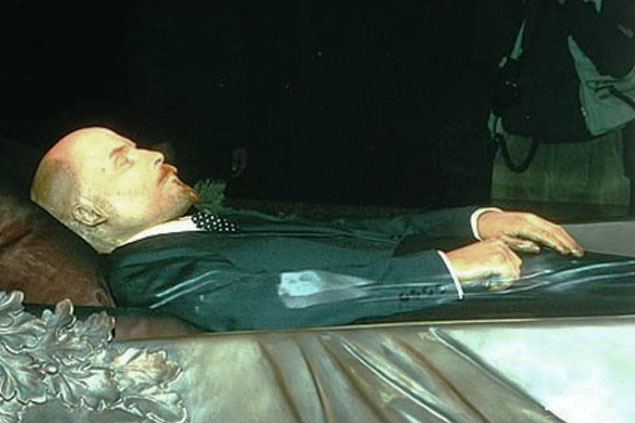
In October 1917 Vladimir Lenin oversaw the October Revolution in Petrograd Russia. It was a seismic political shift that changed the face of the world as we know it. It was arguably responsible for the outcome of the second world war, the proliferation of nuclear weapons, and the rise and fall of many despots and villains from the tip of Chile to the Hearts of Africa and Asia.

He oversaw the Red Terror, a campaign of political repression and executions that solidified the communist party’s rule. He was seen by many in Russia as a heroic socialist working tirelessly for the people. Others saw him as a tyrant and state executioner.

Lenin’s legacy

When he died in 1924, there were waves of public emotion. A wooden mausoleum was erected to display his body which was visited by thousands of people, circling in the bitter cold. He had wanted to be buried and his wife was desperate to fulfil his wish. However, the Soviet authorities had different ideas. 56 days after he died, they commissioned a group of scientists to ensure that Lenin’s remains could exist in perpetuity as a mummy and monument to Soviet ideals.

First, they removed his internal organs and replaced his blood with embalming fluid. Then he was steeped in a preservative solution for 6 months to slowly replace the water in his cells. His brain was removed to be dissected, in the hope of uncovering the secrets to his success (instead they found massive amounts of sclerosis, a serious and debilitating build-up of plaque in the brain). Eventually, his body was placed into a concrete bunker, covered in marble where it has lain for nearly 100 years – immaculately kept in stasis, in an artificially controlled environment, with temperature and humidity maintained to prevent decay.

However, no amount of control can prevent bacterial and fungal growth entirely. Every few days, the secretive team of scientists check the body. Every 18 months, the Lenin’s Mummy is moved to the laboratory underneath the mausoleum and re-embalmed. They replace damaged tissue with artificial tissue, whiten any dark spots and ensure the joints continue to work. Most ominously, they test new techniques on unidentified bodies kept in the lab specifically for this purpose.

The good news is that you can be mummified too. Several other leaders have been embalmed in the same way including Kim Jung il and Ho Chi Minh. Both remain chilling intheir respective mausoleums. Not everyone is so fortunate. Agostinho Neto, the first premier of Angola was initially embalmed. However, for some reason, his upkeep was abondoned. He was eventually buried in 1992, 13 years after he died.

Non-linear war

The upkeep of Lenin’s body has cost millions of roubles. Political leaders from Gorbachev to Putin have steered clear of the issue politically, stating that Lenin will finally be buried as he wished when the Russian people are ready.

For some, the upkeep of the body represents something much greater happening in Russia. Up until February 2020, a man named Vladislav Surkov was one of Putin’s right-hand men. He spent 3 years studying theatre direction before graduating with a master’s in economics. He soon shot through the ranks of the Russian Federation.

He’s a fascinating man and caused several stirs with his various essays. His most recent, regarding Ukraine, led to his downfall. Journalist Adam Curtis suggests that Surkov’s ability to meld theatre with politics created a powerful force that meant no one could create any meaningful opposition to Putin and his regime. Surkov would sponsor neo-Nazis. He would sponsor liberal groups. He would sponsor feminists and radicals and moderates. And as a final flourish, he would tell journalists and commentators and critics that this was exactly what he’d done. The technique was part of a wider concept he described as “non-linear war” and was designed to keep any opposition completely off-guard and bewildered, guessing at what was actually going on. This meant that the Party could operate unmolested in the shadows. Combined with an oppressive approach to law and order and a regular scapegoating of minorities, the spectacle provided a petri-dish for unbridled tyranny.

But can such a regime last forever? In much the same way as Lenin’s mummy, it requires a carefully controlled environment to maintain. It requires significant investment to continue the charade, hide the decay and replace any bits falling off with a fake veneer. It needs hidden processes, buried deep underground and covered in cold concrete and marble.

There will be a time to bury Lenin but he will likely be buried in a very different kind of Russia. In the meantime, Lenin’s mummy’s the word.

To learn more about saving democracy, try Timothy Snyder’s book called “On Tyranny” which is available here: https://www.waterstones.com/book/on-tyranny/timothy-snyder/9781847924889

For more Smarticles on tyranny and democracy try 5 Lessons to Help Save Democracy here: https://smarticlesdotcom.wordpress.com/2022/07/21/5-lessons-to-help-save-democracy

Sugar and spice and everything nice: The Elfbar

The first thing that you notice from a distance is usually the colour. Bright but tasteful, tipped with a futuristic blue pinpoint glow. As you get a little closer, it begins to scintillate your other senses. Sweet clouds billow across the space and fill your nose with fruity aromatics. When you take a drag, there is a kick as the vapour hits the back of your throat and fills your chest. And when you pull away, ready to exhale, your lips are teased with a sweetness – like some sort of tropical essence. Sounds great, right?

For those who don’t know, the Elfbar is a small, lipstick-size nicotine vape pen which has taken the scene by storm. You can buy it everywhere: online, in vape stores and in most corner shops. Their popularity is exponential and, as with any craze, it’s interesting to understand some of the potential reasons why this seemingly innocuous, fruity little handheld nicotine dispenser has become so popular.

Talent is hitting a target no one else can hit; genius is hitting a target no one else can see

Elfbars have managed to crack a couple of serious problems that have plagued the vaping industry in the decade since its inception.

  1. Technically, it’s not a tobacco product

Since it became clear in the 1960s that tobacco products cause cancer (despite almost every effort from big tobacco to distract and confuse the issue), there have been countless laws and departments set up globally to regulate its use and help protect users. From the World Health Organization to the Chinese Ministry of Health to the American Alcohol, Tobacco and Firearms (ATF) law enforcement agency – tobacco has been subject to mountains of legislation and scrutiny from hundreds of eyes throughout the world. And this applies to products that have been derived from tobacco too. This means anything that has been made from or with a tobacco plant, or has used tobacco at any point in its production, is subject to the same scrutiny as tobacco itself. So if I want to use tobacco-derived nicotine in my brand new vape pen, I need to make sure that I meet the regulatory and safety standards of the various countries and authorities, or else I’m in trouble.

This is a problem for the vape industry because it means that any nicotine that comes from tobacco is often subject to the same regulation and scrutiny as tobacco itself. This scrutiny could impact profits. So what’s the best way to overcome this hurdle?

This is where the first genius stroke comes to play for vapes such as the Elfbar. The Elfbar, and those like it, use synthetic nicotine. This is created fresh in a lab from base chemicals and, despite having an identical chemical makeup to tobacco-derived nicotine, is technically not a tobacco product. This helps to circumvent that pesky, profit-preventing protective legislation that has been set up over the last 70 years to govern tobacco products.

  • The best business models provide predictable revenue

One of the biggest promises that vaping made to users was the level of choice that it presented. With a single big purchase, they could have a vape for life. With some minor upkeep, changing a coil here and a battery there, your vape could keep going for ages. The other thing this did was opened up a vast range of choices for the consumer. Different flavours, experiences, character and nicotine content. Various providers, commercial experiences and customer care. The reusable vape opened up a thriving and competitive buyers’ market where consumers could quite literally pick their poison in ways that were never previously possible, even during the glory days of big tobacco.

This is a problem if I’m a vape manufacturer who wants to maximise my profits. I don’t want to turn vaping into a hobby sport. I don’t want profit to go to other niche e-liquid producers or superior coil manufacturers. And, I don’t want people ingesting less of the addictive substance that will keep them coming back. I want people to be incentivised to reliably buy my product all the time, over and over again. This is where the second stroke of genius hits. Elfbars last for 1 or 2 days. They cannot be refilled. They cannot be reused. What could be seen as waste by other sectors is marketed by Elfbar as simplicity. This means when the insipid clouds finally stop drawing from the Elfbars’ sleek black mouthpiece, the only option is to throw it away and pay a premium for an entirely new Elfbar product.

Think about this from a revenue perspective. This means that for every customer who is habitually using an Elfbar, there is guaranteed revenue, to Elfbar and the Elfbar alone, of around £700 per annum. This type of metric is a shareholder’s dream (and an environmentalist’s nightmare).

  • The best product is one that keeps you coming back for more

Elfbars contain 20mg of nicotine. They use a nicotine salt rather than liquid or “freebase”. This is marketed as a smoother hit. In reality, nicotine salts release nicotine far more readily and far more potently than traditional e-liquids, meaning that users get a bigger hit per puff than other mediums, including even cigarettes.

In a cigarette, most of the nicotine will burn off. This means that, despite containing nearly 20mg of nicotine, a user will only consume around a fifth of that amount per cigarette. Comparatively, the atomising technology used in vapes means that the delivery of nicotine through the vapour is much more potent. Curiously, for Elfbars, their atomisers are developed and manufactured by a small company in China, otherwise specialising in commercial fans.

So, ex-smokers are getting more of a hit than they’ve ever enjoyed before. And non-smokers, people who have bought an Elfbar in a corner shop and only started to vape because it’s colourful and tastes nice – they are getting a hit that not only rivals but supersedes the nicotine hit that most people got when they tried their first cigarette.

Finally, traditional vape e-liquids used to taste horrific. They were bitter, foul-tasting syrups that would make you splutter if you got any in your mouth. One of the main evolutionary purposes of taste is to detect poisons. Most poisons taste bitter*. Nicotine is one of the most toxic substances on the planet, hence its use in pesticides, so it makes sense that e-liquids would taste bad. Not the Elfbar juice though. That tastes sweet. The designers of the Elfbar have created the pen so that it leaves a sweet residue on your lips after you have taken a drag. And if there’s one thing the brain loves nearly as much as nicotine, it’s sugar.

*Not all poisons are bitter. Lead poisioning was incredibly common throughout history before people began to suspect the metal was toxic. It was used in everything, in paint, fuel and even to make toys. This was a problem as one of the biggest risks was to children. Why? Lead tastes sweet. Prior to the first attempts to ban lead paint in the 1920s, one of the easiest ways a child could be exposed to lead poisoning was by licking the sweet lead-painted walls at home.

Slugs and snails and puppy dog’s tails

So Elfbar’s are genius. They have a sleek, modern brand aimed toward young people. They smell good, they taste good. They feel good. You can buy them everywhere. And when you’re done, you can buy another one and another one and another one; for a premium of course.

Just like the big tobacco companies before them, this style of vape represents a pinnacle of a collaboration between business people, fashionistas and scientists.

Despite the environmental concerns, the deliberate avoidance of regulation and the intentional trashing of the planet, one of the most concerning things about the Elfbar is that it is really hard to find out who makes them and where the money goes.

Fairly standard questions we would ask of most products we put into our bodies remain utterly unanswered in the case of the Elfbar. Who makes it? Who owns the IP? Who manufactures them at such scale (the company that makes the atomiser for Elfbar has posted revenues of around $2.5M – which feels small for the scale of production seen in the UK). Does this mean there is an external investment? If so, from who? Most importantly, where is the money is going?

Why is this important? Because when regulatory bodies finally catch up and the evidence is finally in, people deserve to know who came up with the idea to hook their previously un-smoking kids onto fruity, glowing, overpriced death sticks.

Elfbar’s marketing discusses the virtues of their innovation

How to survive a freefall

Read Time: 2 mins

Grandmother’s wisdom suggests that getting back up after a fall is important. It’s a metaphor and is designed to help us steer ourselves away from the incapacitating quality of despair. There is a rich tapestry of psychological reasons why getting up is important.

But that isn’t what this piece is about. Because to get back up, you have to survive a fall. And as we know from films like Fight Club, Batman and World War Z, falling out of planes is, in fact, incredibly common.

The advice below is to help you survive an actual, real-life, death-defying, Hollywood fall from a plane.

Key things to consider:

  1. You have 1 – 3 minutes before you hit the ground. Try not to panic as this time could save your life.
  2. You can steer:
    • Forwards = pull your arms back at the shoulders and extend your legs straight
    • Backwards = arms forwards and try and touch your head with your heels
    • Left Turn= slightly dip your left shoulder
    • Right Turn = slightly dip your right shoulder
  3. Although some people survive falls from great heights unscathed, you may need to call for help after you land. So don’t take a selfie on the way down and risk losing your phone.


On water:

  • Water is tricky. It can hurt but there is a lot of evidence to say that a fall into water from a very high altitude is survivable.
  • Frothy or bubbling water is preferable. The faster you are travelling the better some studies suggest. If you’re at sea, and you see a boat, then it may be prudent to aim for near the ship so that the sailors can help you out.
  • To increase your chance of surviving, adopt a pencil shape so you land feet first, with your hands together over your head. This decreases the chance of head trauma or too many broken limbs and is the most common position falling survivors have reported taking.

On land

  • Obviously try and avoid concrete, rock or other unforgiving materials. Best to avoid jagged and pointy things too. Ideally, you want soft ground like powder snow or a marsh. Thick vegetation is second best, but could also end up kebabing you so be wary (although it’s fair to say your options may be limited by this point).
  • Gentle slopes are good as they will take away some of your momentum on the way down.
  • You can travel a few miles horizontally in the time it takes you to reach the ground, so take some time to find the best spot.
  • When nearing the ground, try to relax, bend your knees slightly and protect your head with your arms in case you bounce – it’s the second impact that is more likely to get you than the first.

Believe it or not, throughout history, there have been a surprising number of people who survive falling from great heights. All is not lost.

So, whether your plane has been blown up by an evil villain, and you’re one of those people who inevitably get sucked out of the gaping hole in the side of the plane, or if a superhero has just lasered the fuselage in half or if you simply need a break from those m*****king snakes, you have just increased your life expectancy.

The other option is that whenever you go on holiday, pack a parachute (most commercial parachutes for skydiving or base jumping will fit within the Commercial Airline’s ever-shrinking free carry-on luggage limit).

The above is for entertainment purposes only and should not be relied upon in the case of rapid and involuntary decent. Look at a quality range of skydiving equipment here: https://squirrel.ws/parachutes

5 Lessons to Help Save Democracy

Read Time: 5 mins

History does not repeat, but it does inform. This is the key takeaway of Timothy Snyder’s book “On Tyranny – 20 lessons from the 20th Century”.

Globalization was accelerating in the 1900s and its rise led to complexities that no one could have predicted. These changes were frightening and ever-present. Inventions such as the radio promised to pump this chaos directly into your front room. Globalization fundamentally changed the nature of trust, precipitating a shift in how we dealt with both strangers and institutions. This chaos presented an opportunity for new ideologies to take hold.

Fascism offered simplicity by relying on ancient myths of grandeur and glory. The way to revive this illusory golden era, they claimed, was via a united and glorious purpose, underpinned by the will of the people. The challenge was that relying on historical myths often leads to an acceptance of modern conspiracy. By trying to simplify the complexity of the new global world, the narratives that sought to make sense of reality instead became over-simplified then toxic and ultimately genocidal.

On the other hand, Communism was born from a band of elites and intellectuals who felt they had discovered the fundamental laws by which society should operate. They believed that by following those laws exactly, even in the face of common sense, the complexity of the world could be controlled. In reality, ignoring the randomness and complexity of life meant that their framework became first wasteful, then meaningless and finally deadly.

Brandenburg Gate, Berlin, 1939

Synder warns us that modern society naively feels inoculated from the ravages of tyranny.

After all, there has been peace in (central) Europe for nearly 100 years. The progress in technology would leave the Russian Bolsheviks of the 1920s aghast. We live longer, we are more educated, absolute poverty has decreased, and literacy rates are higher than ever before. We learn about the rise of Nazism in school and every November 11th we remember those who fell in battle defending our freedom. How could it happen to us?

Well, the problem of complexity still remains. If anything, it’s accelerating. The indomitable march of technology has amplified it and made sure that complexity is now more pervasive than even the most powerful radio could have achieved. The advertising model, the 24-hour news cycle and unprecedented data collection have, both directly and indirectly, led to increasingly vicious attacks on democracy.

He’s just so orange (Photo by SAUL LOEB/AFP via Getty Images)

But there are things we can do.

Below is a summary of 5 lessons from Timothy Snyder’s book.

5 of 20 Lessons from the twentieth century

4) Take responsibility for the face of the world

Our ability to see and conceptualise patterns predates language by millennia. So it’s no surprise that a picture paints a thousand words, and less surprising still that symbols play such an integral role in promoting ideologies.

This lesson argues that we should care about the things we see. Throughout history, symbols have been promulgated by Power to marginalise. The yellow star was used to denote Jewish shops and eventually people in Nazi Germany. Posters depicting rich farmers as pigs were used in the Soviet Union. More recently, the characterisation of migrants as vermin in the United Kingdom.

To help protect against tyranny, the concept here is simple – if you wish to display a symbol, such as a lapel pin or a poster in your living room window,  ensure that the symbol is inclusive rather than exclusive.

5) Remember professional ethics

There are many professions that are guided by a more substantial authority than the government of the day. Doctors take their Hippocratic oath, to first do no harm. Lawyers work to and within the letter of the law. Judges swear an oath to serve the people. Police officers perform an “attestation” to fairness, impartiality and fundamental human rights.

This lesson makes the case that there are many professions whose skills are needed to seed a new tyrannical system. The tyrant must first break down the institutions they wish to subvert in order to gain absolute power. This is very difficult if people view their professional ethics as their primary moral compass.

In Nazi Germany, if lawyers had observed habeas corpus (the right to a fair trial), if Doctors had observed their Hippocratic oath, if civil servants and bureaucrats had observed their commitments to human rights and refused to process documents that sanctioned murder, it would have been much more difficult for the state to operate with such a devastating legacy.

The advice is to act on our professional and personal ethics rather than those imposed by Power.

9) Be kind to language

Tyrants will do their best to hijack language. Otherwise banal or neutral events can be twisted to fit the narrative of emerging power. Often they will use phrases like “absolutely destroys” instead of “makes a good point”, or “fake news” instead of “different opinion” or “enemy of the people” instead of “leader of the opposition”. In each case, specific words narrow our ability to think critically about a given situation.

To compound this issue, there is an ever greater reliance on short-form visual stimuli (news segments or reels on social media for example). Tyrants will try to steal away the time we need to sit and reflect on concepts or events. It is in the interest of the tyrant to continually bombard you with new “breaking” or “trending” stories – so many that each new story displaces the previous story before you’ve had time to actually think about it.

In this lesson, the point is that by engaging on their terms and using the language they have prescribed, we inadvertently narrow our own perspective to that of the tyrant. We limit our own ability to discuss or even consider the wider picture. When we only consume information via short-form videos and reels, we don’t give ourselves time to understand what our point of view on a topic actually is. The result is an increasingly compliant and non-critical society; a perfect petri-dish for despotism.

The solution – use your own words whenever you describe a situation, instead of relying on words that have been put in your mouth by the grubby mitts of the media. Secondly, we can read more. Books, essays and long-form arguments (including long podcasts) give you time to interpret and quantify your opinions and help you see the big picture again.

19) Be a patriot

The word “patriot” is often used by tyrants. But it does not mean what they tell you it means. Patriotism is defined as a passion to serve one’s country and defend its laws and institutions.

This is critical. To be a patriot is to love and serve one’s country, its laws and its institutions. It is very difficult to form an argument where the exclusion, denigration or attacking of other people or countries fits the true definition of patriotism.

The thing that tyrants will often refer to as patriotism is in fact nationalism. That’s a different kettle of fish. Nationalism is exclusive. It promotes the self-interest of the state (and often the tyrant) at the expense of others. It is a belief that the state will benefit from acting independently rather than as part of a collective. In its worst form, it goes further, suggesting that the benefits of the state should only be enjoyed by a certain type of person (known as ethnonationalism).

In schools, children in the UK are taught about core British values. This includes democracy, the rule of law, individual liberty and tolerance for those of different faiths and beliefs.

When you contrast these values that children seem to be able to grasp to the rap sheet of the outgoing Prime Minister, the Right Honourable Boris Johnson, you can see that his actions are far from the definition of patriotism:

  • Proroguing (suspending) parliament to dodge the democratic process (see more here)
  • The only Prime Minister in history to have been caught breaking the law in office (see more here)
  • Overseeing the obliteration of the right to protest (see more here)
  • Use of  racist slurs when referring to people with different faiths and beliefs (see examples here)
  • Alleged collusion with ex-KGB agent Alexander Lebedev and then giving Lebedev’s son a Peerage in the house of Lords the year he was elected). (See Carole Cadwalladr’s report here)

Patriotism is important because, in its true form, it allows us to see the toxic roots of tyrannical and nationalistic thinking, and recognise that they pose a danger to one’s country. True patriots work to actively work to stop tyranny, not invoke it.

12) Make eye contact and small talk

This lesson is essential because it is the one that most of us can do every single day.

One of the things that happened during the purges in the Soviet Union and during the pogroms in Nazi Germany is that social interaction took on a sharp quality. The character of your interactions – people averting their gaze or ignoring you when you said hello – was a good indication of your status in the eyes of the tyrannical system. In short, it usually meant you were next.

Paranoia and suspicion fuel a tyrannical system, enabling secret police forces, collaborators and fear. This is because the relationship with the state begins to overwhelm the trust in the local community – your neighbours, your mechanic, bar staff, bus drivers and the owner of your local shop or market stall.

Simply by making eye contact and engaging in small talk, you strengthen the bonds of community. These relationships, however superficial, undermine tyrannical systems. This in turn is why they try desperately to destroy them with Us and Them narratives.

See it, say it, sorted – right?

Timothy Snyder’s book is a pocket-sized slap in the face that has a profound impact on anyone interested in preserving freedom and democracy in a world full of power structures that seem intent on destroying it. The 5 lessons above are cherry-picked. All 20 are fascinating and poignant. You can purchase On Tyranny and other works by Timothy Snyder here: https://www.timothysnyder.org/books

Can you gamble your way to heaven?

It has been argued that the people of France are the best protesters in the world. Since 2018, over 3 million people participated in the Gilet Jaunes movement. The point was to protest against the prices of fuel, cost of living and inequality. They bought the French government to its knees. And more importantly, they did so wearing the very uniform of the powers that they felt oppressed them – the high visibility vest.

This wasn’t the first time the French had came to play.

Before the turn of the 17th century, the church was the judge, jury and executioner of western Europe. It dictated over society and philosophy, often times on pain of death.

The enlightenment of the 1600s was almost a miracle in and of itself. It is universally responsible for the world we live in today, both good and bad. It was a time that broke the yoke of the church and its control on the people and the state. It led to new movements of individuality and thinking – most notably in the breaking away of the new concept of evidence-based science from the two-thousand-year-old notion of “natural philosophy”.

One of the key thinkers was a man called Rene Descartes. His book – Meditations – threw sand in the eyes of religious scholars at the time. In it, he suggested that the only thing that anyone can be absolutely certain of, beyond all measure of trickery, hallucination or doubt, is that you, as an individual mind, exist. His work is summed up in the maxim “I think, therefore I am”. The book was published in common French at the time, as opposed to Latin, which was the fashion back then. Part of his genius was that Latin was far less well understood than French among the people. As a result, the book took France by storm. Its cynical view of reality upset all those who believed unswervingly in the existence of God.

However, what the French take away, they also give. Shortly after Descartes published his book, another Frenchman, named Blaise Pascal, took to the stage. He embellished Descartes’ view. He suggested that if I can think, then I can also gamble.

Pascal’s Wager

Pascal argued that although Descartes had proven that the existence of God wasn’t certain, one should live as if it were. Why? Simple. The benefits outweighed the costs. If one lived life with all manner of pleasure and sin and God wasn’t real, then who cares. It doesn’t matter. Death is death. See you later. However, if God was real, then that same life of strife and sin would condemn a soul to eternal damnation.

If you lived a life of purity, however, despite your doubt, then you would be granted a ticket to eternal exaltation.

In Pascal’s eyes, it was better to hope for the best and plan for the worst. Live as if God is real, even if you didn’t believe in it. Then you’ll be safe either way.

The House always wins

But what if St Paul at the gates of heaven looms over you and asks “Well what did you really think?”. You stare up at him, a little dazed following your hopefully peaceful passing and say “Ah well, I thought it was better that I hedged my bets”.

Would the almighty be happy with anyone who tried to game the system? Who knows. But critics of Pascal’s wager suggest that living this double life would surely serve against you. No one likes a liar. Especially not the almighty. So maybe embracing your life of pleasure is the better way to go.

It’s a tricky one. But is there a way to engage with Pascal’s wager without being disingenuous? Probably. And if so, it would surely entail the tenants that are generally shared by all religions. Be nice. Be kind. Don’t kill each other. And most importantly, don’t covet thy neighbour’s oxen (we’ve all been there).

Logical Fallacies

Read time: 2 mins

Despite what most people think, Ancient Greeks were avid perfumers. The streets of Athens were infused with the delicate herbal scents of almonds, coriander, bergamot and conifer, steeped in olive oil over many months and liberally applied to skin and hair.

Compared to modern chemical and alcoholic perfumes, these scents were more natural and herbaceous. The concoctions were often blessed by the ancient Greek gods of women, wisdom, love and hunting, and left in open containers for people to waft and enjoy as they went about their days.

Smelling good was important, but it was only a small part of surviving in Ancient Greece. In a highly social and litigious society, the ability to persuade was essential. And so, a group of teachers soon rose up who were concerned with helping the nobility survive by teaching them the art of rhetoric. They taught philosophy, politics, culture and most importantly, persuasion.

These people were known as the Sophists and, much like the modern spin doctor, their teachings were very expensive. Not a lot survives of their work. What does remain is in the form of eviscerating criticism from the likes of famous ancient thinkers such as Plato and Socrates.

Plato and Socrates believed that the Sophists were not interested in truth, but instead, only concerned themselves with power. Their techniques did little to help humanity and merely sought to manipulate and deceive. This negative influence has lingered. In English, a sophism is now defined as a fallacious argument.

Members of the Turkish Parliament demonstrate why smelling good is so important in politics.

Against Sophism

Despite the original texts being lost, many of techniques of the sophists survive, and knowing how to recognise them can help you sniff out bad actors before they do too much damage.

Below is a guide to the more common and more insidious fallacies:

  • Strawman Argument – misrepresenting someone’s argument to make it easier to attack.
    • E.g. “It is important to protect the privacy of our citizens online” the mayor exclaimed. “I know you love terrorists but if you’ve got nothing to hide you’ve got nothing to fear” retorted his opponent.
  • Fallacy of composition and division – taking the qualities of a part of something and applying it to the whole or vice versa.
    • E.g.  “Petrol makes cars go fast, so, if I drink enough petrol then I will be able to go faster” (composition) or; “I like watching Netflix on my computer. My computer is made up of lots of parts. So I must be able to watch Netflix on this keyboard” (division)
  • Bandwagon– stating that an argument is valid because a lot of people believe it.
    • E.g. “Everyone knows the sun revolves around the earth,” thought everyone before the 1500s
  • Argument Ad Hominem – literally meaning “to the person”, this fallacy attacks an argument based on the person stating it.
    • E.g. “Bert is a liar and a thief so not only is his argument false but he probably stole it from someone else”
  • Slippery Slope – an argument that says if A happens, it will inevitably lead to Z, despite the two outcomes bearing little to no causal relationship to each other.
    • E.g. “if we allow same-sex marriage, Norfolk will become flooded” a genuine line of reasoning from a fart of a man in UK politics.
  • Begging the question – this is where the argument is based on its own premise and conclusion.
    • E.g. “Vodka is the best drink because all other drinks are worse.”
  • Circular Reasoning – similar to begging the question, the argument begins with the conclusion it is trying to prove.
    • E.g. “All single men are bachelors because anyone who is a bachelor is a single man”
  • No True Scotsman – known as an argument from purity, this fallacy invokes some ideal or standard to prove a point.
    • E.g. “Greg doesn’t douse his cornflakes in whiskey in the morning like a REAL Scotsman. Therefore Greg is not a Scotsman.”
  • Ignoratio Elenchi – Latin for “chatting shit”, this refers to an argument which may have valid statements but fails to address the point.
    • E.g. “I’m not allergic to peanuts which means that they are, in fact, a legume”
  • Tu quoque – this evades dealing with the argument by turning the argument back on the accuser.
    • E.g “I know I had loads of illegal parties constantly during lockdown while people were dying in droves, but you had that pizza and a beer that time so it’s fine.”
  • Appeal to authority – this is the idea that if a credible source believes something, it must be true.
    • E.g. “ the president thinks that immigration is a problem for the economy and he’s the president so he must be right”
    • This does not mean that research and evidence done by experts should be simply disregarded. But, it does support the ideas of scrutiny and independent review.

There are many more. A quick review of PMQs will demonstrate how heavily politicians lean into these sophistic techniques. They are, at best, lazy attempts to hide a dangerous lack of knowledge and at worst, a systematic assault on logic and reason made by bad actors in order to hide the truth by any means necessary.

Pro tip: A great way to get out of talking to someone you don’t like is to point out all of their logical fallacies during the conversation. You can see a full list of logical fallacies by following this link: https://www.logicalfallacies.org/