El Fajo
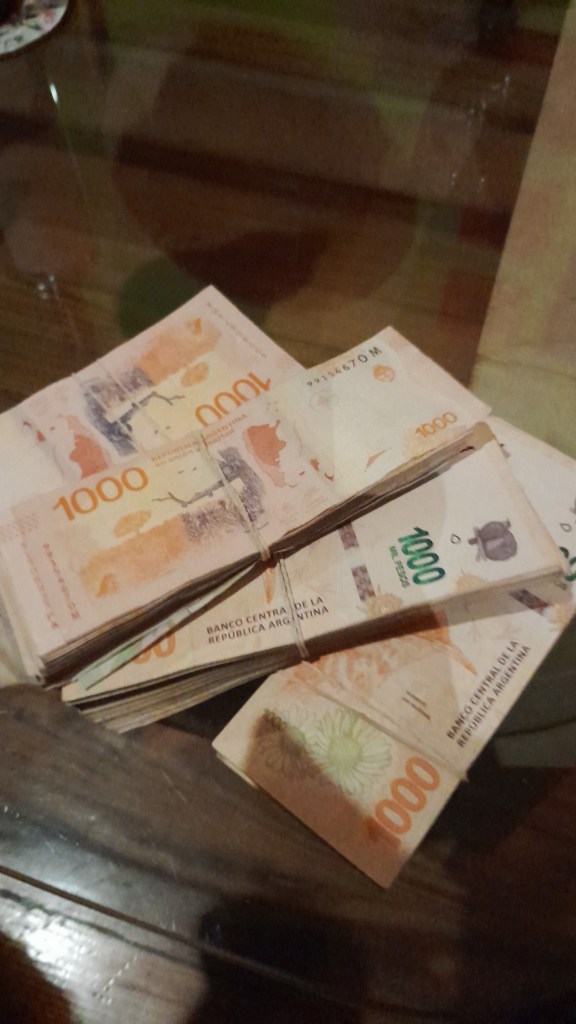
It was beyond clear it was time to pay up. The surrounding murmur grew quiet as he reached into his pocket. He pulled out a bundle of cash, ten thousand, twenty thousand at least. He held a cigarette in his teeth, the blue smoke curling up and around the brim of his Stetson hat.
“Keep the change”
Who is this maverick? What kind of adrenaline-fuelled, high-stakes situation has he got himself into?
In reality, he’s just a guy in Argentina paying for dinner.
In 2024, the country’s annual inflation rate hit more than 300%. Things that were once worth tens of pesos are now worth thousands. The treasury can’t keep up. Up until recently, the largest denomination was 2000 pesos. That was worth £1.50 at the time of writing.
This has changed with the introduction of a 10,000 bill and even more recently a 20,000 pesos bill.
I am always nosey when I visit a new Airbnb. If there are pots to be explored or drawers left unlocked, I can’t help but pry. It gives me a glimpse into the hidden lives of my hosts and lets me conjure little stories about the lives they have lived.
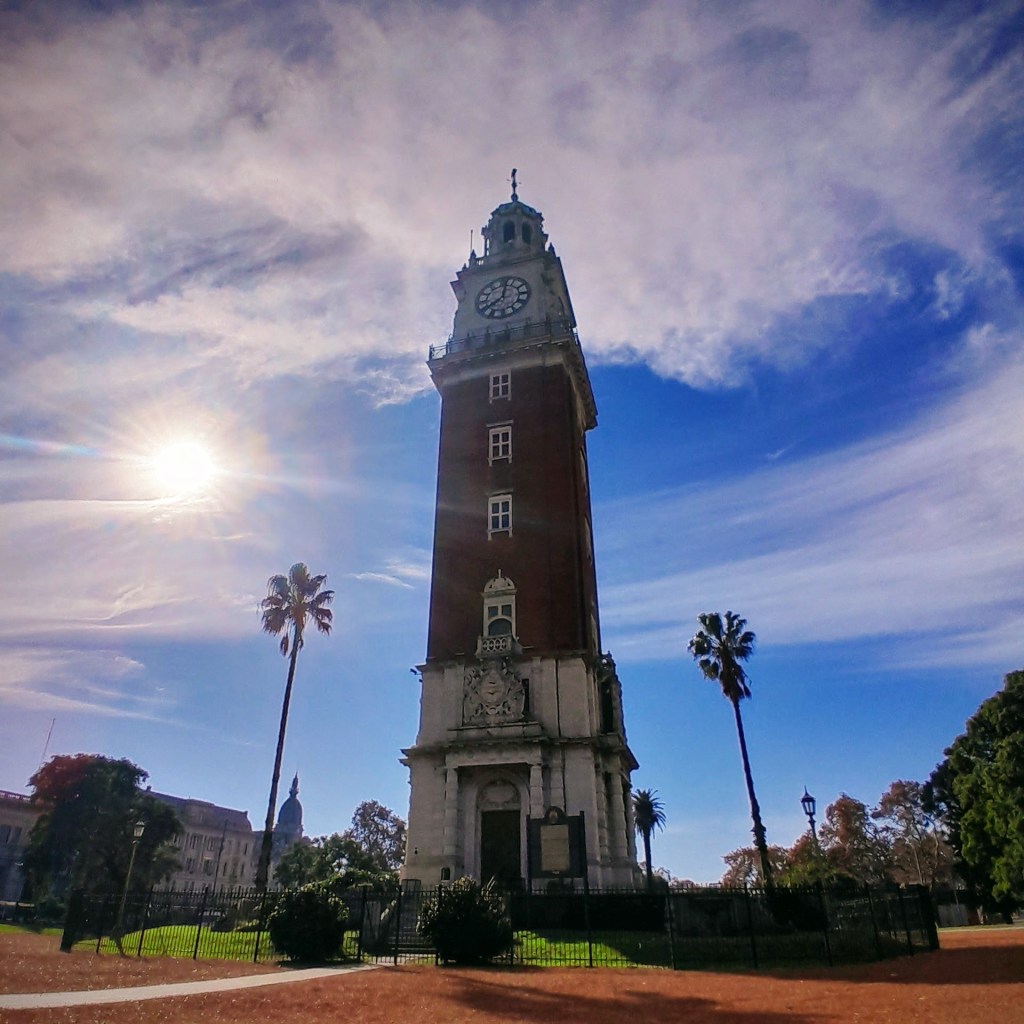
In Buenos Aries, in a large Edwardian building of many stories, like a pig, I was truffling. I always do this at new AirBnBs. I love to explore the little containers, jars, shelves and drawers. Our host was fascinating, a rich bookshelf, and mannequins adorned with half-finished outfits. Naked brickwork and a skylight made out of inlaid spirit bottles. I loved these people. It was one of those flats where the hosts had poured their personality into the mortar and their soul into the very air of the place. It smelled like an old bookshop.
As I was rummaging, I came across a little clay pot (one of my favourite items to nose around in). Inside were a pile of 1 peso coins. I picked it up and held it in the light. The jar held 17 pesos in coins. A year ago, this would have been enough for a metro ticket across the city. Overnight, the new administration stripped away subsidies for public transport, increasing the price of the fare to more than 400 pesos. I put the coins back gingerly, very aware that the metal in the coin was worth more than their value.
Luckily these policies don’t hurt the rich. Just, as usual, everybody else.
El Futilidad
Is it a coincidence that two countries who butted heads over a piece of rock in the Atlantic Ocean are now so fucked?
The Falklands War cost both countries billions of dollars.
In Argentina, inflation is through the roof as the government scrambles to address the deficit with a number of libertarian, classic conservative and populist moves.
In the UK, a new government is picking up the pieces after 14 years of stagnation, an isolationist coup which took the country out of the world’s biggest single market, and corruption that has crippled public services and increased the cost of living by 20%.
With the benefit of hindsight, it feels like we’ve got more in common than we’d care to admit. Namely, if we’d both spent a little more time focusing on what was going on at home and a little less time pissing into the wind over some rock covered in sheep food, I might still be able to buy crisps for less than £1.50 and the Argentinians wouldn’t need to take a suitcase of cash to buy a coffee.
Los Niños
It was a brutal climb, up thousands of meters. The permafrost was biting at the young woman’s limbs and stinging her face. In her arms, she held her daughter. She’s excited, she’s about to turn 6. But this morning, she’s uncharacteristically quiet, eyes wide as she looks around at the rich red robes and feathered headdresses adorned by their host.
The young woman was weeping silently. The gravity of the situation gouged a great pit in her stomach. But this was a time to rejoice, not a time for tears. Instead, she fusses at her daughter’s red tunic, one foot moving in front of the other.
After a few hours, the air is thin. The group comes to a small hut. It has a base of large rocks with a wooden frame. They congregate, the murmur increasing as they take her daughter from her arms. They bring a small flask to her thin lips, encouraging her to drink deeply. She does. They say she’s a good girl. That’s why she’s here after all. Only the best can be brought to honour the mountain.
With the flask now empty, one of the men takes a small bone pipe and packs it with cocoa leaves before blowing it onto the little girl’s now slackened lips. The alcohol has taken effect, her tiny head lilting to one side, unable to completely support its own weight.
When the blow comes it’s mercifully quick. The mother watches, she has to. It’s an honour. But the sound as the club connects with bone, that thick, wet crack, will stay with her forever.
With care, her daughter is wrapped in fine cloth and placed into the shrine. Tears begin to steam, so hot and thick that it feels like they will melt the snow beneath her. Soon, the ritual is over. The mountain is appeased. They will have a respite from the fire and the smoke and the wrath of the gods – for a time at least. The young woman descends with the others, a part of her heart and soul forever left on that tall mountain peak. But she does not feel lighter for its loss.
Later…
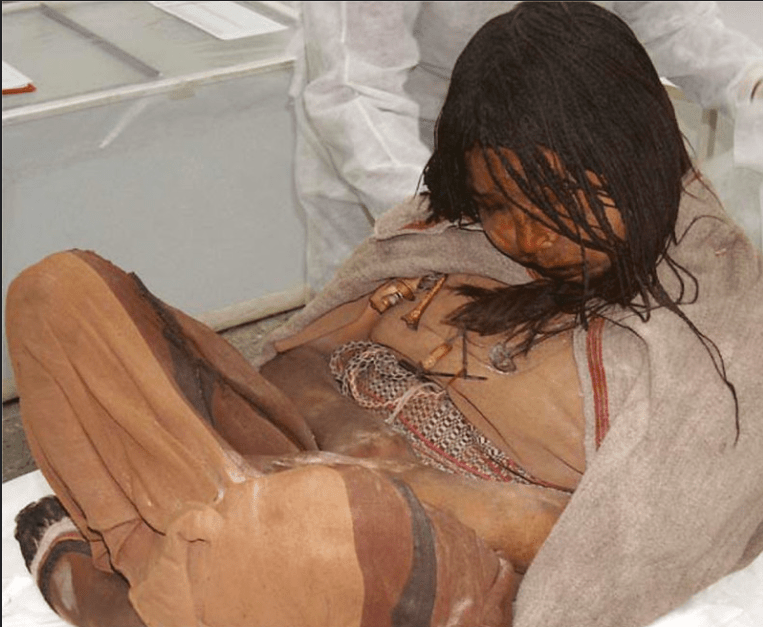
A biting cold wind stung his face. He checks his map and looks up into the clear blue sky. It’s 1999. Johan Rienhard and his team are about to notice a pile of rocks. He will uncover the preserved remains of 3 young children, a small sample of the countless human sacrifices made by the Inca to appease powers they didn’t understand.
They were taken and stored in cryogenic stasis. For only £3, you can see this monument to uncertainty and despair. You can try to understand.
El Hombre Verde
For once I was alone at the crossroads, cars zipping by. I scanned the bright yellow traffic lights searching for a little man who would shepherd my crossing. But there was nothing. He’d abandoned me.
I’d got used to crossing roads in South America, unapologetically using old people as cover. If they’d made it this far, they must have a knack for knowing when it’s safe to cross. While road markings and zebra crossings were routinely ignored, they did exist and there had been a modicum of respect in the other countries I’d visited. Drivers would look around corners and slow if they saw you about to cross.
Argentina wasn’t like this. The little green man, who in Medellin walks with you and speeds up as the time runs out, had abandoned me. There simply wasn’t one. Just your wits and blind luck.
And the drivers in Argentina speed up when they see you coming.
Normally I feel it’s uncouth to run when you cross the road. But in Argentina, it’s a necessity.
El Ferrocarril
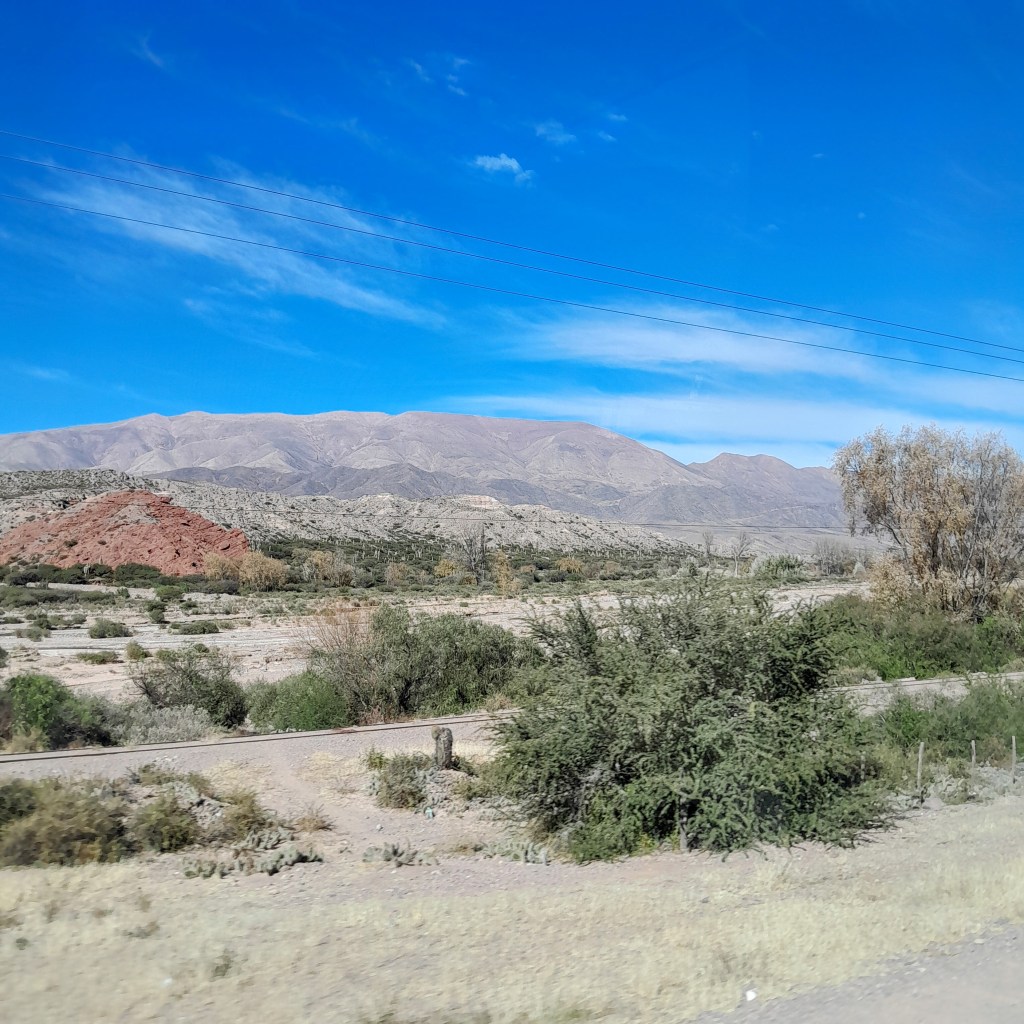
The river cut a wide arch through the great hills of stratified rock in shades of red and orange, purples, greys and browns.
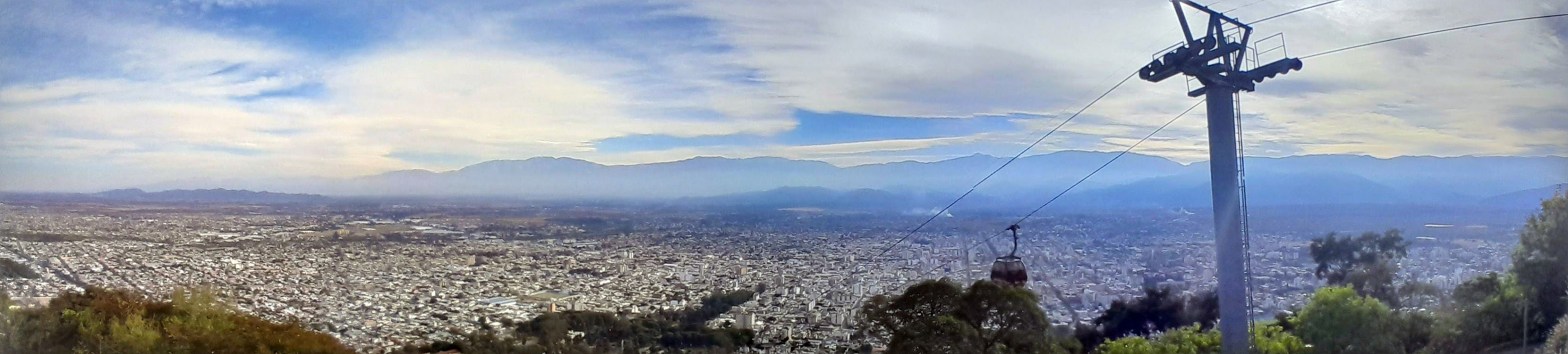
The bus trundled along the highway, my forehead resting against the cool glass. My eyes were locked, following a pair of train tracks. They’d likely begun their journey in La Quiaca, the land border between Bolivia and Argentina. But I’d only just noticed them. They traced the route of the road as we made our way to the northern city of Salta.
They were the dull colour of rust and stood on a raised bank of earth. Sometimes, the earth had eroded away, leaving only the tracks suspended precariously in the air. Sometimes they would disappear underneath village houses, only to reappear again when we passed the village boundary. Sometimes large tracts had been sheared clean off, repurposed for something else. But mostly, they were whole. A solid, unchanging line, a constant as the scenery around them shifted and morphed.
Anoemia is a word coined by American writer John Koenig. It refers to a kind of second-hand nostalgia – a longing for a time that you yourself never experienced. It can be fostered through watching films or the stories of your parents and grandparents. Or, as it turns out, through watching a pair of train tracks follow you through the Argentine campo.
They were part of the General Belgrano Railway, once the largest railway network in South America spanning more than 10,000km. A relic of Argentina’s golden era, the grand Belgrano Railway connected the beating heart of Buenos Aries with provinces throughout the country. They used a “narrow gauge” which offers lower speeds and stability but is much easier to build and maintain in mountainous environments. The General Belgrano was a thriving network throughout the late 19th and 20th centuries.
However, the network began to decline and was eventually privatised, leading to large parts being abandoned.
The bus slowed. The river had widened to some 500m, the water flowing quickly and dangerously. The tracks had swerved away from the road and into the flowing water. If there had been a bridge, time and neglect had taken their toll. Only a solitary pillar remained. Suddenly one of the tracks fell away sharply. It had never occurred to me that a single train track would look so wrong. So lonely.
We approached Salta, the buildings obscuring my view as the bus mingled with other trucks and traffic. I didn’t see the tracks again.
Javier Milei
A populist. A libertarian. A madman. The president.
You’d be forgiven for thinking Milei all of these things, especially considering the foaming commentary that comes from the Western media. It was certainly my view when I sat down on my JetSmart flight to Buenos Aries. That’s when Max sat down next to me.
“The thing is, you have to consider what it was like before,” he tells me. Max is a PT, an American, who’s lived in Argentina for 8 years. “Just because the last lot weren’t in the news doesn’t mean they were any good”.
He’s talking about Alberto Fernandez, the previous President of Argentina who oversaw rampant hyperinflation while steeped in allegations of extensive and endemic corruption.
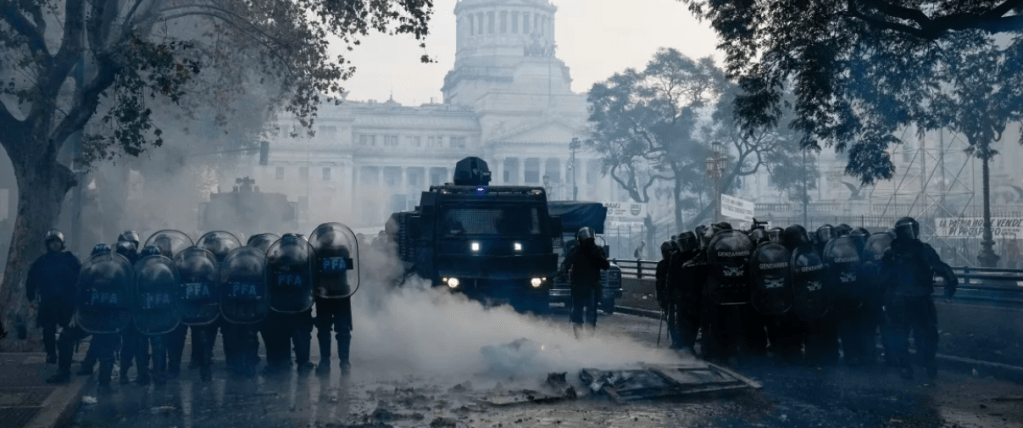
To say the people didn’t like Fernandez would be an understatement. For context, in 2001, former president Fernando de la Rua’s policies had caused rampant inflation and a bank run, followed by waves of massive violence and political unrest. It was so bad that he had to escape the capital by helicopter.
Fernandez, the previous president, had lower approval ratings than the guy who ran away in a helicopter.
Seeing your country collapse while your president and his mates keep getting richer is a justifiable reason to become frustrated. We in the UK know how that feels. But that’s not the only thing that helped stoke Milei’s fires.
“They were everywhere, when I left college, even when I started work”. This is Gabi now, an English teacher. She’s talking about La Campora, a group that started off as a grassroots movement to garner support for then-president Nestor Kirchner.
Kirchner’s presidency in 2003 fostered a period of recovery – debt restructuring, state intervention and good luck on the global commodity market all helped. La Campora was a well-intended group trying to encourage young people to do their part. That soon changed.
As their influence grew, senior members began to find real power – in the cabinet and in Congress. What had started as a grassroots movement became the establishment. “There was real pressure to think like them and I don’t want to think like them, I want to think for myself”.
There’s a school of thought that the influence of La Campora is one of the reasons that the young vote shifted to Milei as much as it did. He refers to them as a “political caste” and, to the delight of many Argentinians, is happy to pick a fight with them.
Milei’s policies have been successful in reducing inflation and increasing growth, at least in the short term. His libertarian outlook is favourable for businesses looking to invest in Argentina, as is his commitment to dollarisation. So what’s the problem?
Keep your enemies close…
Milei annoys progressives. Of course, he does. He likes guns and privatisation. He doesn’t like abortion, although he’s ambivalent about LGBTQ+. He also makes things up sometimes when it suits his agenda, but again, this is expected with the world’s politicians at the moment.
But he doesn’t seem to be overtly corrupt. His message, that things will need to get worse before they can get better and that this means a period of aggressive austerity, appeals to a populace who had more or less lost hope. Compared to the last lot, he’s a fresh take.
Dr Javier Milei. An economist. A blue flame thinker. The president?
You can tell a lot about someone through the company they keep. During the early stages of his election, he was criticised for who he was rubbing shoulders with. Victor Orban, Bolsanaro. Not great people. But then the West was too busy sneering at the time to give Milei the time of day, so you could argue that was through necessity.
Keep Your Friends Closer…
But his cabinet is also full of some curious figures. One of Milei’s key advisors is a man called Santiago Caputo. He’s a spin doctor with a fascination with the Russian underworld, sporting tattoos that would be at home on a Mafioso. Worryingly, he oversaw the complete restructuring of the intelligence services and is now apparently in control of its budget. It’s hard to imagine he hasn’t taken at least some operational power. It’s been widely suggested that he is the second most powerful man in Argentina. And yet, he has had fewer than 90 minutes in the public eye. No interviews, no time in parliament. Nada.
His sister, Karina Milei, is also very active in setting policy and was key to her brother’s ascendancy. She apparently shares his ideology (or may have been responsible for forming it) and is now the General Secretary to the President. Presumably, that means you have to get through her to get to the president. She, like Caputo, is camera shy, with only a handful of public appearances under her belt. That’s not necessarily a bad thing. But it’s good for those setting policy to face public criticism so they can explain their position – for better or worse.
Then there’s the vice president. Victoria Villaruala has spoken up for the victims who died fighting for the military dictatorship, suggesting that too much focus has been put on the victims of state terrorism. It’s alleged she had a relationship with the leader and mastermind of the Military Junta, Jorge Rafael Videla, while he was imprisoned. Apparently, they met up to chat about the good old days.
To be clear, the good old days refer to the “Dirty War”, famous for the disappearance of between 10,000 and 30,000 people, many held in 1 of 500 secret detention centres.
If you were lucky, you were only tortured. If you were unlucky, you were thrown alive out of an aircraft into the sea.
It’s not what you know…
I loved Argentina so much that I can’t wait to go back. I want its economy to stabilise and for its natural wealth to pour forth and make the lives of its people better.
I hope that Milei knows what he’s doing. He’s in bed with some scary people.
This is part 5 of my series on South America. To learn more about Colombia, click here. To learn more about Peru, click here. To learn more about Ecuador, click here. To learn more about Bolivia, click here.
 Smarticles