
El Enejo
Bolivians have more of a reason to be angry than most. Despite the recent economic upturn which has led to an impressive reduction in poverty and an increase in living standards (especially for the indigenous populations), Bolivia’s history is one of rampant pillage and plunder. It remains one of the poorest countries in South America.
The city of Potosi is the home of Cerro Rico (the rich hill). It’s a mountain more than 4000m above sea level. Buried in its depths were rich seams of unimaginable sincerity and beauty. When the Spanish stumbled across these caves, they began to mine the mountain, its wealth fuelling the chaos wrought by their deformed and feckless monarchy.
They used the native people as slaves. They died in unimaginable numbers in hellish conditions. Rebellions were ruthlessly crushed. And the silver-lined alters of churches and the tables of banquettes – any of it that wasn’t shipped off to the homeland to be paid immediately to Spain’s creditors (namely the English and the Flemish).
The mines of Potosi were coveted by Bolivia’s neighbours. While never directly assaulted, it’s widely thought that the War of the Pacific with Chile (where Bolivia lost its coastal region and became landlocked), the Acre War with Brazil (where Bolivia lost its access to rubber production), and the Chaco War with Paraguay (where Bolivia lost a significant portion of the oil-rich Chaco region) were all enacted with one eye on Bolivia’s mountain treasure trove.
Then there’s the impact of modern empires – things like aid that were dependent on birth control, financial exploitation and long-term loans, and the continuing export of Bolivian wealth.
It’s true that Bolivia gained independence from Spain in 1825, but she left her banks and businesses behind, safe and sound.
Put this brutal history together and you’d expect the Bolivian people to be bellicose and enraged. But in reality, there has been a huge rise in living standards, a decrease in inequality, a huge investment in infrastructure and a reduction in poverty. Life here is getting better (despite the occasional attempted coup).
Something striking when compared to Colombia, a much richer nation, is that development in Colombia is centred around building new resorts and hulking tower blocks catering to tourists and digital nomads. In Bolivia, conversely, you see roads being built.
However, there are still dangers lurking on the horizon. The salt flats of Uyuni, 10,000 km2 of beautiful white crystal stretching as far as the eye can see, are also the richest deposit of lithium in the world. China has expressed a $99 billion dollar desire to extract this precious metal. As our guide Pelagio (62) muttered, darkness is his eyes, it would be devastating to see history repeat itself.
Uyuni
The only thing whiter than the brilliant salt flats of Uyuni is the clientele of Minuteman Pizza. It also happens to be one of the best pizzas I’ve had in South America. While the rest of the small pueblo becomes a frigid ghost town once the sun sets to a dull purple, the blazing fires of their pizza ovens roar deliciously. The comforting din of conversation wafts through the perpetually packed restaurant, a welcome reprieve from an otherwise stark and isolated ambiance.
Elsewhere, what the town lacks in warmth, the locals more than makeup for. At a local grill, “La Chapaquita”, once you’ve enjoyed a slab of mouth-watering beef and chorizo, the owner will pull his guitar out of nowhere and serenade you with folk songs of love and loss, reminiscent of Bolivia’s sad history.
At its heart, Uyuni is an industrial town. Currently, it’s at a strange intersection between tourism and industry. This gulf is likely to grow as lithium refineries begin to break up the otherwise pristine landscape.
Despite the cold and the uncertain future, it’s nice to find a little slice of homestead hospitality.
El Sal
The spectre of colour at dawn is breathtaking. Its occurrence made even more so by the absence of colour throughout the rest of the day.
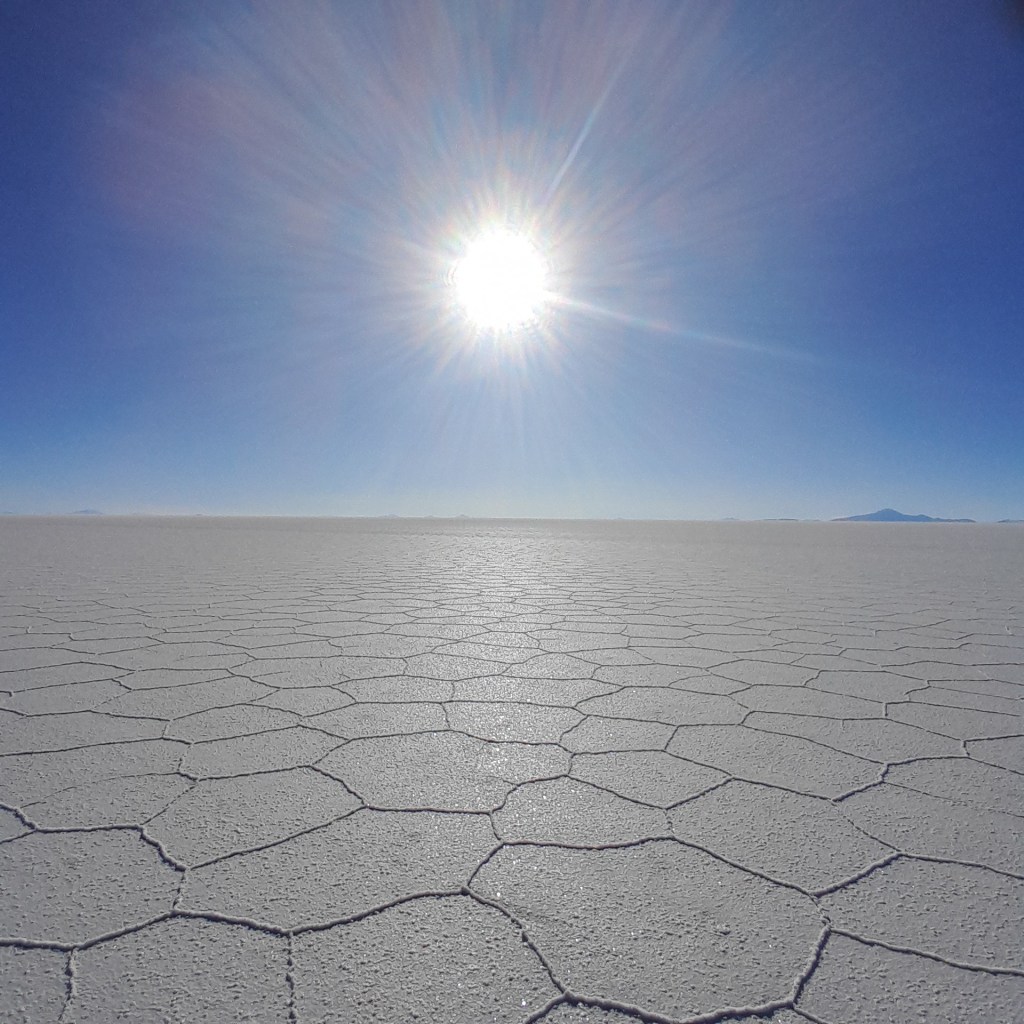
Before the reflections and sunsets and sunrises, the salt itself has a chaotic geometry. Be it the tire tracks, enshrined in salt until the next wet season or the hexagonal crust formed by the evaporation of subterranean lake, the spikey crystals submerged under saline water or the blotchy entropy elsewhere – each square centimetre is utterly unique up close.
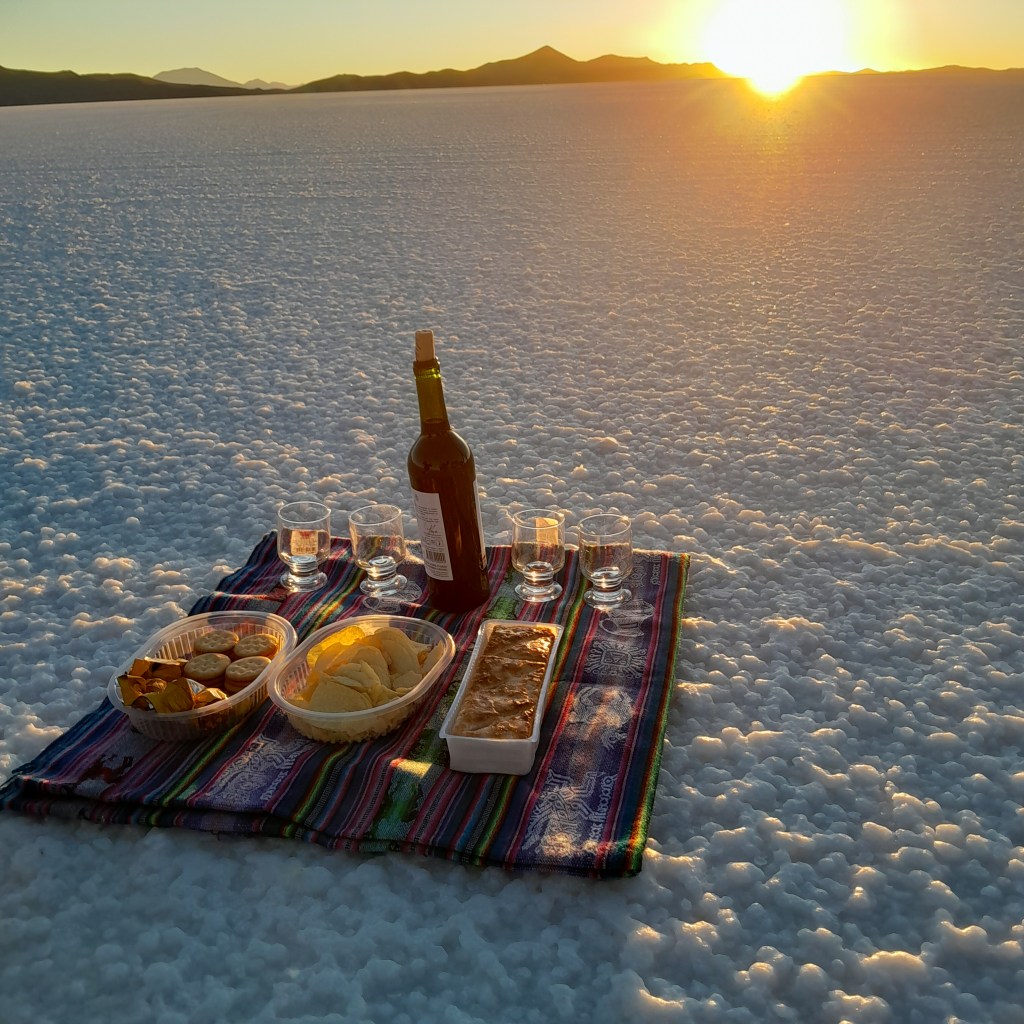
Put them together and you have blinding, beautiful conformity. When the sun hits each crystal, they dance, a sparking kaleidoscope that spans miles in every direction. Then you look up. Then there’s colour. The deep, rich sky blue becomes hues of red and orange and purple at sunset or pastel brilliance at sunrise.
In the coldest gloom, minutes before sunrise, the 0° ambiance, the wind whips through your clothes, stealing away any precious warmth you may have mustered. The only solace is that you know the sun will rise soon. The growing brightness at the horizon, matched by utter silence, hypnotises you. Your breath mists and curls around the rim of your hood. The day begins. The gloom gives way to the sparkling kaleidoscope of dawn. Within minutes, the ground becomes a solid white and the sky, rich blue once more – the colours of sun and salt hidden again until the day’s close.
La Salvacion
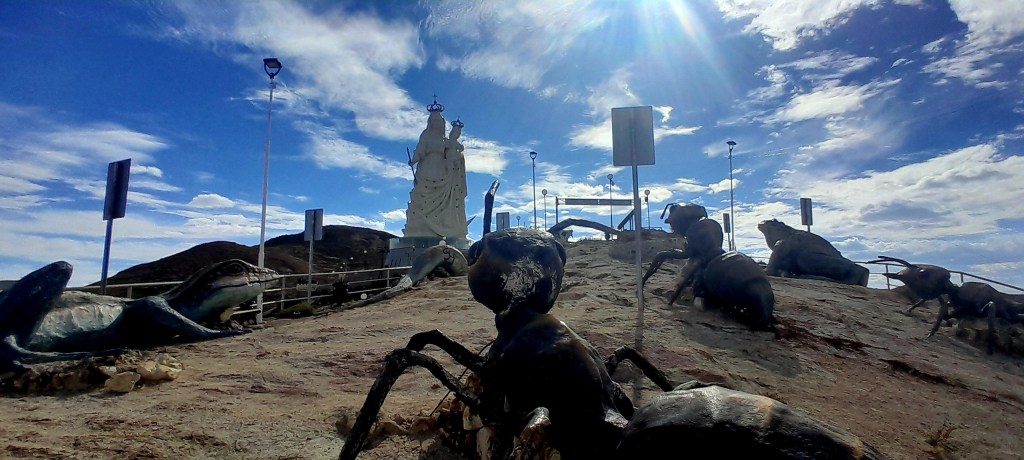
The legend of Oruro talks of 5 great plagues from the north southeast and west, under the voracious gaze of a giant Condor.
They came to wipe out the Uru people. The giant serpent, its scales slithering across the mountains and carving a path, sounded like a jet engine. Next, the earth-shattering, seismic jolts of a great toad, rented massive dents into the landscape.
They were followed by a lizard, scampering over the mountain zenith, tongue flicking to taste the air. It yawned, its bright orange maw spewing a plague of ants towards the people of Oruro.
If it weren’t for the grace of the Virgin saint, these beasts would have flourished. Luckily faith prevailed and good old silver mining could resume once more.
The Bolivian landscape lends itself to such tales. It’s easy to look at the glacial scars and conjure stories about great beasts, the fingertips of God sculpturing the very valleys.
I’m sceptical. If it was the fingers of God sculpting the land, I expect the valleys are more like the scratch marks left by the Almighty’s fingernails as humans banished Him with their greed and blasted his creations with their avarice – assisted by a great deal of dynamite.
El Aislamiento
If you climb one of the mountains of Bolivia’s Altiplano, you can see plains that extend for hundreds of miles. Except for some of the bigger settlements, places like Oruro, mostly these Andean flatlands are home to thousands of tiny communities. They seem to sprout from nowhere, taking the place of the conspicuously absent trees. Houses of characteristic red brick and corrugated steel. Sometimes a wall will simply partition a bit of land, seemingly for no purpose, saving it for a future that perhaps never came.
It’s rare to see people. The only real evidence that people live here is when your bus stops and someone gets off and begins marching across scrubland, presumably towards home. It’s impossible not to wonder where they’re heading.
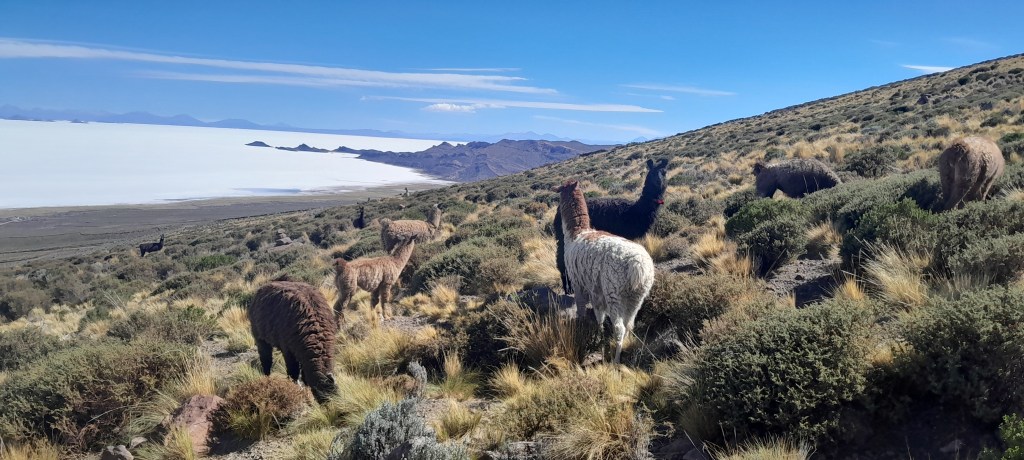
The population density in Bolivia is about 9 people per square kilometre. For context, in England, it’s 280. Most of the population is centred in the cities. That means that the shepherds you pass, with their flocks of sheep or llamas, will walk a marathon every day and not see a soul. It’s easy to sometimes wonder if this is part of the reason for the Bolivian people’s calm.
Alone
Often in company we play a role. We say one thing, avoid talking about another. It’s all contextual, based on where we are and who we’re with. We think often about our measure and status, even if subconsciously. We pour like sand into the context we’re facing, socially or professionally, ever conscious of the echo we’ll receive.
When you’re alone, this context evaporates. There is no echo. This initial freedom can be disconcerting. Often, you’ll circle back to old contexts. Humans so frequently favour the negative over the positive (as part of our inherited survival mechanism), meaning the contexts we relive are often the least favourable (or perhaps the ones our subconscious feels we could learn the most from).
But soon, this subsides and the lack of context and echo gives you more room. There’s clarity in isolation. It may not always provide answers, and certainly won’t solve problems (which are often people-based), but it can clarify the question. Like hearing a single crisp note ring out when the chatter in the restaurant of life falls silent.
It’s possible that this is all too metaphorical. I appreciate that. But there is something else that happens when you spend time alone. You realise the extent to which you value and miss what you have. And also why you miss it. The passing and spontaneous insight of your friends, the jokes you think of that you know would make them laugh. A hug from someone you truly love.
Solitude gets its substance from its contrast to company. To truly experience and appreciate one, you must experience and appreciate the other.
And, if all else fails, you can always get yourself a flock of llamas.
This is part 3 of a series on South America. To learn more about Colombia, click here. To learn more about Peru, click here. To learn more about Ecuador, click here.
 Smarticles
One thought on “The Bolivia Set”