The Doolittle Moment
Whales have an emotional range larger than humans can possibly imagine. The part of their brain responsible for emotion is immense. Its size means that whales are likely to have stronger and far more profound emotions than we damned dirty apes could ever fathom. In the same way that our turns of phrase, senses of humour, accents and vocabulary are passed down through our parents and our social group, whale song is passed down over generations. But as of yet, we have no idea what whales are talking about. In fact, talking to animals seems entirely impossible. But we might be closer to a real-life Dr Doolittle than we think.
Talking to animals.
We know that animals communicate, we can hear them talking to each other. In fact, we know that plants communicate too. Recent studies have looked at how plants react to the sound of approaching pollinators and have found that Primrose produces a greater quantity of sweeter nectar when it hears the sound of an approaching bee (compared to control noises like traffic or white noise). We also know that tomato and tobacco plants effectively “scream” at a pitch far higher than humans can hear when they’re stressed.
However, knowing that animals can communicate doesn’t make communicating with them any easier. First and foremost, most of us couldn’t pick apart 2 animal sounds if we tried (we even disagree about what farm animals sound like – look up the sound a cockerel makes according to different countries in the world). Now try to imagine the difference between a ring-tailed lemur and a ruffed lemur.
However, recently, the advances in AI mean that we are closer than we have ever been to talking to animals.
The Rosetta stone

Ancient Egyptian hieroglyphs are unlike any written language we in the present day had ever seen. When they were first discovered, it wasn’t clear that they were even a form of communication. Then, the Rosetta stone was discovered in 1799 and brought to Europe to be studied.
The Rosetta stone is a decree issued during the Ptolemaic dynasty in 196 BC. What makes it special is the fact that the stone has exactly the same decree, practically word for word, but written in 3 different languages – two different types of Egyptian scripts and finally Ancient Greek. Why was this so important? At the time, we were not able to translate the ancient Egyptian. But we were able to translate the ancient Greek.
The Rosetta stone opened doors to understanding the ancient world in new ways. Without a Rosetta Stone, this would have been nearly impossible. But most animals don’t have an alphabet, let alone carve their language into stone. How does this help us in talking to animals?
Large Language Models
Lots of modern AI is based on large language models. In simple terms, they analyse huge amounts of language data and then use maths to predict what the most likely letters and words should come next. When we visualise this, we see that the predictions the large language model makes tend to group around loose concepts. For example, the word “apple” is closely related to other words like “red”, “juice”, “fruit” and so on. It’s less closely related to the word “citrus” and hardly related to the word “Chernobyl”. For a human, that makes sense. Of course “apple” is related to “fruit” and not “Chernobyl”. Although a large language model does not understand concepts, through the sheer tonnage of data it’s exposed to, it can create a cogent and coherent response to our questions.
In short, with enough data and complex mathematics, these models can communicate with us despite having no true understanding.
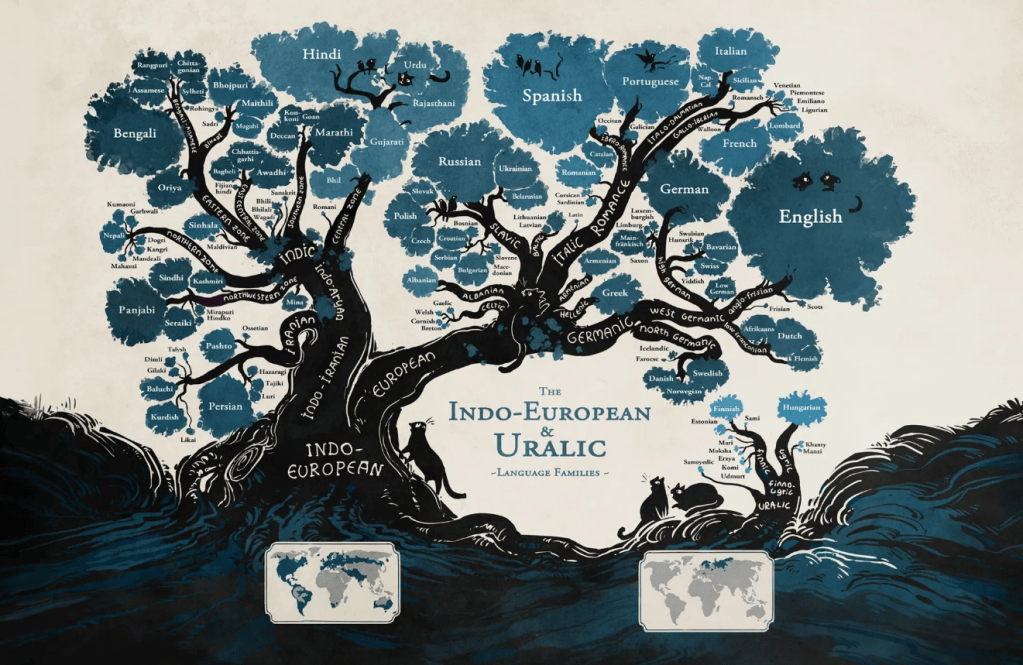
What’s curious is that regardless of which language it is, or even the root of a language (Italic versus Germanic versus Indic for example) – the structures all seem to follow the same sort of shape. The same concepts, regardless of the words or sounds we use to convey them, tend to group in the same way all over the world. So, the thinking goes, if Human languages share similar conceptual structures, maybe animal languages do too. All we need to do is look for and then map concepts that we might share with our animal counterparts – in essence, creating our own Rosetta Stone.
Why might they overlap?
It’s obvious animals won’t have concepts like technology or reality TV (unlucky for them). But there might be some crossover in other ways:
The mirror tests – turns out animals are as vain as we are. Put a mirror in front of a dolphin and it will use the mirror to look at parts of itself it can’t normally see. This is also a common test for human infants in order to test their development. It means that, like us, dolphins have some sense of self.
Getting high – dolphins deliberately irritate pufferfish and sting themselves before passing the puffer ‘pon the left-hand side. Lemurs also use the bite of a particular type of centipede to get a little pickled. In both cases, this behaviour shows that they are seeking an elevated state of consciousness, whatever this may look like, in the same way that humans do when drinking alcohol or other psycho effective substances.
Using these areas of possible overlap and others like them, an organisation called the Earth Species Project is starting to build a language model, but for animals. However, we are a long way from meaningful progress just yet. There are some big problems that need to be overcome before we can start to debate the finer points with Fido.
Barriers to understanding
- Cocktail Party Effect – this is the idea that humans are able to isolate specific sounds and meanings in a very noisy environment. In a crowded room, full of noise, you are able to hear the person you’re speaking to and understand them clearly, or hear your name called by a familiar voice across the room. The problem with something like whale song for example is that it’s really hard to isolate which whale is which. In a pod, there could be tens of whales all communicating at the same time. Isolating an individual is proving to be a bit tricky.
- Multi-modal communication – anyone who has had the pleasure, nay the privilege, of taking a corporate communications course will know that words only make up a tiny segment of human communication. The rest is non-verbal, things like body language and tone. The challenge for researchers is to find a way to input this visual information – movements, dancing, whatever it is – into meaning.
In any case, due to the immense power of AI, it seems likely at this stage that we will be able to communicate with animals before we understand how or why we can communicate. This raises some issues of its own:
- Compulsion – without a thorough understanding of the communication we are transmitting, it’s possible that we might give commands like “dive” which are harmful. We could inadvertently be forcing animals to do things that are unnatural. This has ethical implications.
- Culture – many of the animals we might want to communicate with have been on the planet far longer than humans – some for millions of years versus homo sapiens 40,000. This means that their communication could hold millennia of history and culture – some of which could be really important, teaching safe places, migratory routes, and places to eat or reproduce. Our attempts at communication could hijack this, with unknowable consequences.
While we are some way off our own Doolittle moment, in the words of Ezra Klein, one of the founders of the Earth Species Project:
“AI opens the aperture of human imagination and human senses so that we can perceive more and understand more.”
You can follow their work through their website here: https://www.earthspecies.org/
 Smarticles