In 1998, a Jazz group called Touch & Go composed an earworm that shot to number 3 in the UK charts. Its saxophone riff is iconic – the link is below if you’d like a quick boogie:
One of the most distinctive aspects of this song is the sample. A dulcet female voice simply says:
- I’ve noticed you around
- I find you very attractive
- Would you go to bed with me?
The song was very popular. It was used in mobile phone and beer adverts and became especially popular in Eastern Europe. But there is more to this sample than simply seduction.
Men are from Mars
The 1970s and 1980s were a time when psychology was desperately trying to get a foothold. It had moved from the abstract dream theories of the psychoanalysts (like Freud and Carl Jung), through the robotic theories of the behaviourists (such as Pavlov and B. F. Skinner) to a more enlightened and humanistic age that was interested in trying to explain our relationships with more than deep subconscious desires or superficial conditioning.
At the time, the general consensus was that men were more open to encounters of a sexual nature than women. Two experimenters, Russell Clark and Elaine Hatfield wanted to find out. They devised an experiment to test the theory.*
“Slightly unattractive”** confederates (the name for people who play along in psychological research) were sent out on College Campuses to ask random strangers a question. They would start by saying:
“I have been noticing you around campus, I find you very attractive”
Then they would ask one of 3 questions:
- Would you go on a date with me tonight?
- Would you come over to my apartment tonight?
- Would you go to bed with me tonight?
The experiment was done with a female confederate and a male confederate to 48 individuals each across 2 experiments, 4 years apart.
*It’s worth noting that these experiments were conducted while same-sex relationships were still criminal in most of the USA (with a number of states only decriminalising same-sex relationships as late as 2003). As a result, there is a conspicuous lack of data on LGBTQ+ preferences.
** A brutal but verbatim quote from the research. The confederates were asked to rate each other. Those who rated an average of 7.5 / 10 attractive on a subjective scale were asked to participate.
Women are from Venus
The results were emphatic and did not change dramatically between the experiments in 1978 and 1982. Below is an aggregate score.
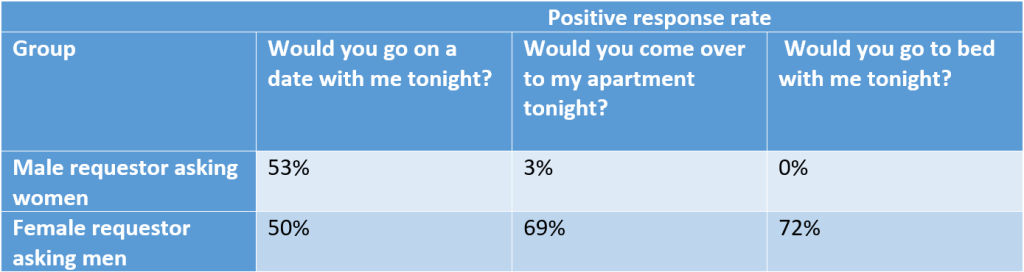
What this shows is that the men in this experiment were 22% more likely to say yes to bedding someone than going on a date (although it’s worth noting that a number of these date rejections were due to existing relationships, prior commitments or diary clashes. It’s also worth noting that the same relationships, prior commitments and diary clashes didn’t seem to dissuade the “would you got to bed with me tonight” group anywhere near as much). Men’s propensity to go to bed with the female confederate increased from 1978 to 1982 by a small margin.
There are many differing explanations for why this could be the case. On the one hand, researchers point to evolutionary potentialities for why women were more selective. This side of the argument suggests there is more cost for women who make a mistake in partner selection. In the most basic sense, there’s the physical cost that women go through when they get pregnant and carry a child to term. There is also the risk of meeting a bad partner with abusive intent. As a result, this theory goes, women are evolutionarily pickier. The other side of this debate focuses on the roles traditionally assigned in society. It was not too long ago that gents were lauded in men’s clubs throughout the world for their promiscuity, while ladies were encouraged to save themselves. As a result, the societal pressures on the participants influenced their responses and make them more traditional such that they adhered to their assigned roles.
But everybody poops
Despite the differences seen in these responses, further research has shown that whatever we think about ourselves, everyone who experiences arousal to the things they are attracted to, does it in more or less the same way. Throughout the 1970s and 1980s, multiple experiments (using some disturbingly named equipment – see page 43 of Clark and Hatfield’s paper below for more details) found that, despite their self-report answers when interviewed (which showed a lot of people deny they were aroused at all when asked), physiologically, everyone is aroused to more or less the same extent when faced with their preferred scenes of a sexual nature.
It would be interesting to repeat these experiments now. The introduction and subsequent pillaging of the sex and dating scene, from apps like Tinder or new adult sites such as OnlyFans, have changed a lot of people’s views about the traditions surrounding sex. This technology promotes casual, voyeuristic, non-lasting relationships. While marketed as liberating and progressive, it’s also true that they are built to maximise profit, so promoting this type of relationship supports their business models and, by extension, their bottom lines.
That said, if the differences were due to evolutionary psychology then it is unlikely there would be significant differences in the results today, even with the normalisation of casual encounters and new technology that’s cropped up since the 1980s. If the responses of participants were due to societal pressure, however, then it’s likely we would see more equilibrium in the results as time goes on. The other fascinating element would be to see how the modern understanding of gender and identity would impact the results if a similar experiment was conducted today, now that people can express themselves and their sexuality more freely, without fear of prison or hard labour (in the U.S.A at least).
Elaine Hatfield is an incredible researcher who has had a great career and has published a huge number of books in the field of human relationships. In 1975 she even had a grant worth $84K taken away from her due to annoying a senator who felt that exploring human relationships was a waste of public money. Her Passionate Love Scale, which tries to measure how in love one can be, is still widely used today. Russell D Clark was a researcher at the University of Kansas. He died in 2011.
The paper: http://www2.hawaii.edu/~elaineh/79.pdf
The Passionate Love Scale: http://www.elainehatfield.com/uploads/3/4/5/2/34523593/passionate_love.pdf
 Smarticles
One thought on “Would you…um?”