Read Time: 1 min
Do you want to be a millionaire? You need to wake up at 5am. Otherwise, you’re doomed to destitution. Countless posts on Tiktok will advise that the only way to be successful is to wake up before the sun rises. But rewinding several millennia, our ancestors had different ideas.
The ancient Egyptians valued sleep. For them, the act of sleep, and more importantly, the act of dreaming, provided a gateway to lands beyond the living. Sleep was the only place one could connect with the gods and truly transform. They built temples specifically for sleeping (as did the ancient Greeks), and the content of these dreams could guide the decisions of families, armies and entire dynasties.
Most people have stopped associating sleep with profound spiritual transformation. But the effects of sleep deprivation have been more widely studied than ever before. A lack of sleep degrades cognitive processing, creates erratic moods, and causes problems with immune function and digestion. Not sleeping at all is fatal. Fatal insomnia is a rare genetic condition that stops a person from being able to fall asleep at all. The prognosis is not good. Everyone dies within a year of onset.
Whether you are interested in caressing the space between the living and the divine lands, or if you just want to be less irritable, mastery of sleep seems essential to a long and happy life (despite the unsolicited advice of sadistic influencers on social media).
Below are some tips laid out by the neuroscientist Andrew Huberman that use some of the oldest facets in our environment to help us sleep.
Sunrise
The eyes have specific cells designed to kickstart key functions in the body. As they detect the first rays of sunrise, these cells rouse the internal body clock. The light begins a cascade of essential life functions – the immune system, alertness, digestion and mood.
Activating these cells is really important. Luckily the sun provides the best possible kickstart to these processes:
- Grab a coffee and stand outside in the sun for anywhere between 5 and 20 minutes. The naked eye is important here, sunglasses will lessen the impact.
- If it’s cloudy, still go outside – the level of light that shines through cloud cover is still significantly more powerful than anything you can get from artificial lights.
- If you wake up before the sun, turn on as many bright lights are possible. Overhead lights are best as these emulate sunshine. Then get your 5 minutes as soon as the sun comes up.
Sunrise
What goes up, must come down. It’s best to avoid things that could activate these cells when it gets close to bedtime. Artificial light is only a few hundred years old which is not enough time for humans to sufficiently evolve and adapt to them. So, keeping things dim is the best option.
So there are some things to do before bed that can help:
- Around 2 hours before your natural bedtime, start to dim the lights around the house.
- Switch from overhead lights to lamps. This helps avoid the sun-like qualities of overhead artificial light.
- Closing your eyes for 10 – 20 minutes before actually going to sleep can also help you to switch off. Huberman calls this non-sleep deep rest (or NSDR) and can help with anxiety around falling asleep.

The effects of heat
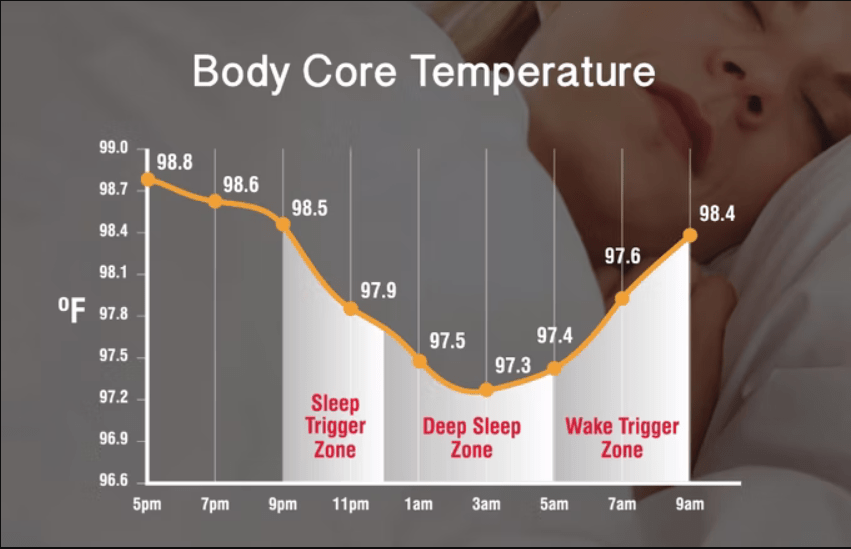
Body temperature is regulated in cycles with your highest body temperature peaking around 6 hours after you get out of bed and your lowest body temperature troughing around 2 hours before your natural waking time. You tend to be more awake the warmer you are.
Your body also takes steps to naturally regulate temperature through the night. Your hands and feet are natural heat dumps which is why you will so often wake up with arms and legs dangling out of your duvet. Oddly, humans universally struggle to sleep without a cover, even a light sheet can make the difference between good sleep and poor sleep.
There are other ways we can use temperature to help us sleep:
- When going to sleep, keep the room cool and warm up with blankets. This will help your body naturally dump heat when it needs to and will allow you to modulate with layers if it’s chilly.
- A cold shower in the morning can kickstart the body’s thermostat and help you achieve optimum temperature more quickly. Equally, a warm shower before bed can encourage the cooling mechanism in the body so that you can fall asleep more easily.
- The ideal scenario is to have the temperature of your room emulate sleeping outside i.e. cooling throughout the evening and warming up in the morning.
The above is for entertainment only and is not medical advice. Andrew Huberman has a great body of work and his thoughts on sleep represent only a small element. His other focuses include brain development, neural plasticity and neuroregeneration. He has a podcast called “Huberman Lab Podcast” available via https://hubermanlab.com/welcome-to-the-huberman-lab-podcast/
 Smarticles