Read time: 2 mins
In 1968, only 3 months after Martin Luther King was assassinated for his services to human progress, 8 mice predicted how humanity would end.
They lived in a rodential paradise. Food was available whenever they required it. The temperature was balmy. There were no predators and plenty of materials to make a nest. And, perhaps most important for a young thriving mouse, there were opportunities to mouse-flirt and reproduce.

And they took the opportunity with gusto. As expected, the first year of mice paradise was booming and the population grew exponentially. After a year, there were 600 mice.
Then things changed.
After day 315, the rate of reproduction started to decline. This coincided with behaviours which were entirely unexpected, for example:
- Parents started to abandon and injure their young.
- Dominant males were unable to hold on to territory or mates.
- Non-dominant males would attack each other, and make no attempt to defend themselves against attack.
Soon, the experimenters started to notice a strange cohort in the midst of the mice. They dubbed them “the beautiful ones”. These mice had clean, well-groomed fur. They didn’t have scars or wounds. Most importantly, they lived an entirely solitary existence. They ate, drank and nested alone, never socialising and never breeding. Eventually, the colony became extinct.
This experiment was seen by its instigator, a brilliant ethnologist and researcher named John B Calhoun, to be a worrying portent of things to come for humanity.
“The conclusions drawn from this experiment,” he wrote “were that when all available space is taken and all social roles filled, competition and the stresses experienced by the individuals will result in a total breakdown in complex social behaviours, ultimately resulting in the demise of the population”
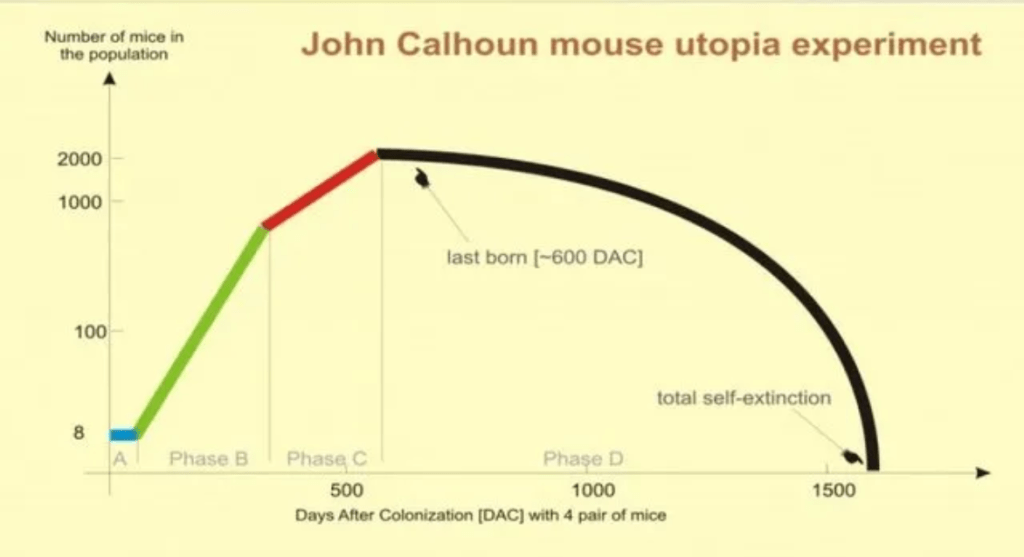
His theory became known as “behavioural sink”. Its application to humans has been challenged and, in some cases, tested. Jonathan Freeman did a series of experiments with willing university students. He suggested that the issue wasn’t the density of the population, but the number of social interactions which was driving the mice nuts. He highlighted the importance of privacy, as well as community.
Another idea is one of social variety – if humans have a variety of social roles, through work or family or hobbies, then it’s possible that the plummeting of the human race into utter oblivion could be slowed or even reversed.
In any case, the study promotes more research on the impact of privacy (much to the delight of introverts everywhere) and the impact of individual purpose on society. It is possible that the meteoric rise of self-help gurus like Tony Robbins or Jordan Peterson is a sort of correction as people try to find their purpose in an ever more complicated and controlled world. The cohort of individualistic mice also inspires more questions about the concept of beauty and the importance placed on it in modern culture.
This piece is inspired by an article in Farnham Street, which provides great insight and clarity from some of the most successful people throughout history. Their podcast, The Knowledge Project, offers timeless insight and comes highly recommended. You can find a link here: https://fs.blog/
 Smarticles