Read time: 3 mins
In October 2021, McDonald’s announced it was testing its new McPlant burger, a vegan product that was created in collaboration with Beyond Meat, a company that specialises in meat alternatives.
The McPlant is an ultra-processed patty inspired by Beyond Meat’s own recipe which uses ingredients such as pea protein, oil, extracts, colourings and stabilisers.
The McPlant adds a vegan product to a menu that is otherwise dominated by meat-based items – with a McDonald’s twist.
Why not just sell Beyond Meat burgers?
McDonald’s is one of the most successful franchises in history. Its global reach helps maintain revenues of over $6 billion. It’s famed for its efficient food processing, cheap pricing, eye-catching marketing and a string of controversies from animal welfare and health to a creative approach to tax.
Like all successful companies, one of the reasons it had reached such dizzying heights is the company’s ingenuity in maximising profits.
Typically, there are 3 ways to increase profits:
- Increase prices
- Cut Costs
- Find a new customer base
The new collaboration helps the chain to engage a new base that has previously been pushed to one side when it comes to the McDonalds product line. This group is comprised of vegetarians and vegans.
The challenge is one of cost. The retail price for 2 uncooked Beyond Meat burgers is set at £5 ($6.77) at the time of writing. This is more than a fully prepared McDonalds meal with a side and a drink.
So, considering the desire to engage a new base and the inability to bump prices, as well as an unwillingness to spend more than absolutely necessary on production, McDonald’s needed to find a way to keep the manufacture and distribution of this new product profitable.
What is a McPlant Burger?
The UK requires the ingredients for any food to be listed in order of weight. This gives an interesting insight into how McDonald’s have changed Beyond Meat’s recipe:
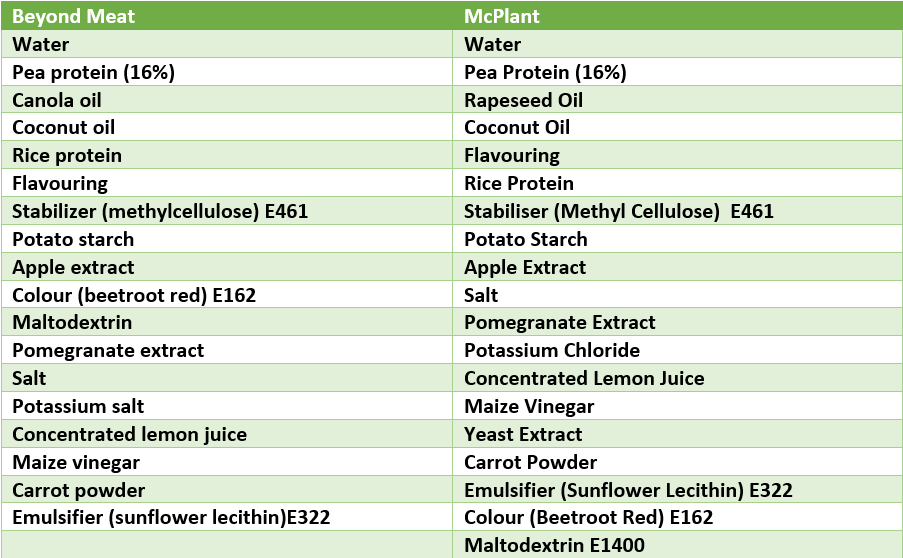
Firstly, there doesn’t seem to be a lot of plants in these plant-based burgers. There are, however, lots of extracts. The production of extracts involves a chemical or industrial process to isolate a specific flavour or element from its main component (e.g. the apple flavour from an apple). Often what is left behind and discarded is the material that provides most of a food’s nutrition.
There are also a surprising number of E numbers in each product. One of these, E461 or Methylcellulose, is a very useful additive that is also used in shampoo, toothpaste, glue and most enticingly, as a laxative.
The McPlant has quite aggressively bumped some things up the list – namely “Flavourings”, “Salt” and “Potassium Chloride”. This is unsurprising. It also seems to have shifted from the lower fat and more expensive “canola oil” to the cheaper and higher in fat “Rapeseed oil”.
The result: a highly processed product that has volumes more salt and fat than its predecessor, making it potentially more addictive to the consumer, while simultaneously reducing the cost of production. Most importantly, a product that can be legitimately marketed as vegan and plant-based.
To infinity?
The recent partnership between one of the world’s largest fast-food chains and one of the world’s most famous providers of meat alternatives has garnered mixed reviews.
The optimists see a new age of fast food, one that is no longer dependent on the waste and suffering of animals. The cynics see another string added to the bow of the fast-food conglomerates, helping them secure more market share while “greenwashing” a notoriously un-green business model.
In either case, the result is the same.
By piggybacking Beyond Meat’s brand, reducing costs by changing the ingredients, adjusting the taste to make the product more salty, fatty and potentially addictive and all the while engaging a previously underrepresented market (vegetarians and vegans), the deal has put both companies in a great position to rake in profits.
As is so often the case, it seems the real winners are the private equity firms and celebrity investors, who can rub their hands like Mr Burns and enjoy watching their investments bloat to sweaty grotesqueness, in roughly the same manner as anyone who eats too many of these burgers.
 Smarticles