Happiness has become the focus for huge swathes of the population, and the quest to find it fuels an industry of gurus and self-help entrepreneurs which has grown by 20% since 2020.
Despite its most recent surge in popularity, seeking happiness is not a new endeavour. In fact, some of the most famous thinkers in history have already taken a punt.
One of the earliest was Aristotle, the Macedonian cognitive powerhouse whose work has influenced everything from maths and science to poetry and literature for thousands of years.
Happiness is an artform
Aristotle lived in a culture that believed every rational being had a purpose. This belief influenced his concept of happiness enormously.
Whereas the modern definition of happiness is often centred around the warm fuzzy feeling you get when you eat cake or hug a friend, Aristotle’s conception was different. He suggested the best definition of happiness is “Eudemonia” – literally translated as flourishing. He believed that happiness comes to people who achieve the best they possibly can in pursuit of their purpose or “universal human good”.
Spheres, excesses and deficiencies
In order to get anywhere near Aristotle’s concept of happiness, he makes it clear that one must live according to some defined moral virtues. If one can act in such a way where every action is completed according to these virtues, then one will flourish and, if followed consistently, become truly happy.
Moral virtues exist on a spectrum between an excess and a deficiency. There are lots of areas in life where one can possess an excess or a deficiency.
Each of these areas is called a sphere and they can apply to lots of different scenarios everyone encounters every day.
The road to a good life is simple – find the balance in each of these spheres and live and act consistently and accordingly. Below, he provides some useful examples:
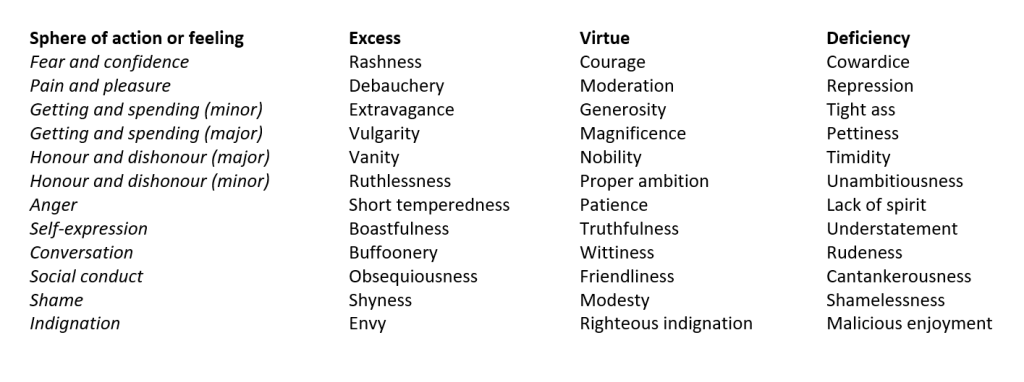
On closer inspection, these seem to make sense. In the sphere of fear and confidence, too much means you can get yourself in serious trouble. You could take on things you aren’t fit for or put yourself and your loved ones in danger. Equally, a coward could create as much damage through inaction. Neither will particularly enjoy life. By Aristotle’s definition, courage is displaying confidence and accepting fear in ways that are appropriate and that will benefit others.
In terms of self-expression, someone who never finds a way to communicate their input or mindset will likely not get very far. Credit will be taken for their ideas and they will garner a reputation that doesn’t align with their skill set. This will chip away at them over time and, as with many excesses or deficiencies, eventually become a self-fulfilling prophecy. The person will likely be miserable. On the other end of the spectrum, someone who boasts about their own exploits is universally hated in civilised company – they will no doubt miss opportunities as a result of the negative feelings they induce. The virtue here is being honest about what you have done and achieved.
Virtue is a doing word
Seeking happiness through virtue is not a passive endeavour. It’s different to an innate ability like being able to see or hear. Instead, happiness is a skill that needs to be practised like a musical instrument or exercised like a muscle. People can only become virtuous by doing things. And not just anything. Learning to rock climb or down a pint in less than a minute isn’t going to cut the mustard. Instead, this theory necessarily requires you to interact with other people.
With this, our ancient Greek guru lays down some ground rules:
- Virtuous actors must be fully conscious.
- They must not have acted virtuously by accident.
- Virtuous acts must come from a consistent disposition and not just every now and then on a whim.
These rules mean that your everyday tyrant can’t accidentally become virtuous and fall into being happy because they forgot to murder a political rival. The psychopath cannot become virtuous by helping someone find their keys, only to con them out of their car as soon as the keys are found. It’s not clear if you can be drunk and virtuous – no theory is perfect.
Conclusion
Aristotle’s writings have lasted for 2400 years, and anything with that level of sticking power usually has something at its core that is worth considering. He is widely credited as the father of everything from logic through to natural law and his writings were the foundation of philosophy and fledgling science until the enlightenment when the scientific method became the guiding principle.
That said, the model doesn’t work for everything. There are some really important spheres that don’t quite fit the excess / deficiency model. Justice, for example, is something that’s discussed and doesn’t fit the model. You’re either unjust or just. You can’t be too just. Friendship also seems difficult to fit into the model and is arguably exceptionally important to leading a happy life. You’re either a friend and you exercise mercy, compassion and tolerance. Or you are not and you don’t.
To answer this, Aristotle suggests that a person can only be truly just or a true friend once they have mastered every other virtue. The challenge is that this seems almost impossible to attain. Nobody is perfect. Everyone has some great friends who are not necessarily virtuous all the time. Batman is obviously just, even if he is a little bit punchy in the way he delivers his justice.
Despite its shortcomings, Aristotle offers something that a lot of modern self-help doesn’t. A high concentration of modern self-help is very inward-looking. The pointy end is saturated with high functioning sociopaths whose advice is centred on becoming successful in an exclusively material sense. So much of this type of commentary is about becoming rich, famous or, if you are very lucky, an influencer. Their advice tends to centre on beating yourself into getting up at 4am, looking ripped, being confident, getting cold hard cash, being more productive than a factory conveyor belt and unflinchingly crushing anyone who gets in your way. In this sense, this self-flagellating brand of self-help sadomasochism seems to focus on excesses – things like vanity, extravagance and ruthlessness.
As effective as this approach purports to be, it has a tiny flaw in that it tends to ignore the rest of humanity. As anyone who has needed a friend can attest to, it’s astounding the impact that one person can have on the world around them.
Aristotle’s approach is impossible to enact without consideration of others and this is why, despite being older than Jesus, it still carries weight. Even now, his ethics offer wise counsel to anyone who feels that virtue, tolerance and consideration are at least as important as a new job title and a six-pack.
Aristotle’s Nicomachean Ethics is a collection of essays that are widely considered to have dominated philosophical and theological thought in the west for more than 1500 years. It was fused into Christian theology in the West and provided a basis for many modern laws. Despite its age, it still reads surprisingly well and is full of great insight and wisdom.
You can find a copy here: https://www.waterstones.com/book/the-nicomachean-ethics/aristotle/jonathan-barnes/9780140449495
 Smarticles