Read Time: 3 mins
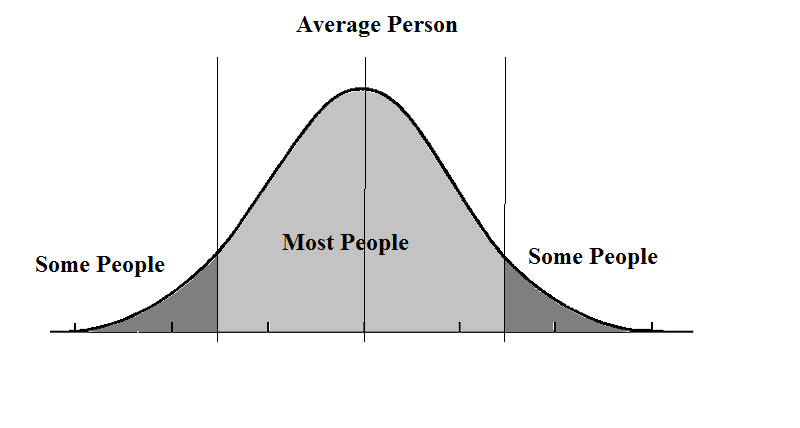
For the most part, there’s nothing wrong with being average. Expectations are reasonable, you are liked by some, not by others. The paparazzi take a limited interest in who you snog and what colour your socks are. Being average typically means you fall somewhere towards the middle of what mathematicians call a normal distribution. This is a fancy name for a bell curve and it applies to a great many human qualities – height, IQ, blood pressure, shoe size. Even birth weight follows a normal distribution.
The un-bell curve
This changes a little when we look at other elements. Unlike the normal distribution or bell curve, the pareto distribution looks very different.
Rather than the majority being focussed in the average as in a bell curve, the majority in a pareto distribution is focussed toward a tiny minority. The graph typically forms a massive hockey stick which is skewed to one side or other. A great example is allocation of wealth. If you look at the distribution of wealth in the US (or indeed across the world) a tiny group of Elon Bezos’es have pretty much all the money. In fact, they have almost as much as the 2 billion poorest people in the world.

This isn’t the only area where the pareto distribution exists. In 2020, there were 275,232 titles published in the US. These sold over 700m units in total. It just so happened that one of these books was the autobiography of former U.S president Barak Obama. His book sold nearly 2.5m copies by itself and was the bestselling book of the year by far. The next best author sold just under 1.5m copies. The following author sold just over 800K copies. And the list continues.
The effect was that the top 10 books hoovered up a mammoth proportion of total unit sales over the year, leaving the other 275,222 books to scrap over what was left.
In the same vein, there have been hundreds of classical pieces written over the course of time, and yet, you will likely only hear a tiny fraction of artists played on Classic FM. Of all the literary classics you’ve ever studied, almost everyone will have read Shakespeare. Most other books from the same era will have been lost to the sands of time.
The Pareto Distribution at work
One of the fascinating applications of this comes into play in business. IQ and personality types follow a standard distribution and most of the workforce will fit somewhere in the middle of the normal distribution, as expected.
Some of the people at the end of the curve will be very talented. They will have the skills, accumen and personality types that tend to lead to corporate success. There will be a similar number on the other end of the scale.
What doesn’t follow a normal distribution however, is how productive these groups are.
Invariably, the skilled and hardworking minority will be more productive than the vast majority and significantly more productive than those in the lower quartiles. It follows a pareto distribution.
As it happens , the top 20% of the top performers in a company will do something like 50% of the work. For a company, this isn’t necessarily the end of the world – part of the reason high performers perform is because they have the personality skills, motivation, background, confidence and drive to do so – in a company that uses good incentives, where teams support each other, the company can continue to profit despite the uneven distribution of productivity.
However, sometimes companies go bad. Lots of things can precipitate a company going bad but usually the symptoms are the same – a cut throat culture, bad incentives, pay freezes, no promotions, inaction when it comes to feedback, bad product development and worse customer service.
This is a problem. When companies go bad and fail to act quickly, people leave.
The first people to get a new job are almost always the top performers. Afterall, they have the best earning potential, the most developed skills, the most suited personality types for their roles and a track record to prove it. They are the first to get new jobs when they become dissatisfied. The problem is, when they find a new job, they take the all of the work they’ve been doing with them.
What’s interesting is that this trend continues all the way down the curve. Of the remaining employees, 20% of them are doing 50% of the remaining work. Guess who’s next to find a new job?
If unmanaged, this bleed can continue as company rips through its long standing employees, seeing a disproportionate and rarely understood dip in productivity as they go. The process is rarely a complete nose dive as most companies will continue to recruit as they lose people. However, if the company has gone bad then its likely they will invest less into recruitment, leading to younger, cheaper, less experienced employees. These employees can occasionally be great fits and high performers but their inexperience will impact their productivity and the company will never get back to the high highs that it may have enjoyed before. More importantly, exceptional new hires are likely to leave as soon as they realise the grass is greener on the other side.
The pareto distribution in terms of productivity can kill companies if they don’t recognise the value of people who are productive. It’s important to consider it’s impact and make sure that incentives are good, the support is there and that people are generally happy.
Also, don’t bother publishing a book the same year as an ex-president.
This is inspired by some of the details in Jordan Peterson’s lecture series on Personality types. Jordan Peterson strikes a controversial pose and his views on the extreme left and extreme right have earned him not-always-glowing notoriety. But one thing that can’t be argued – the man knows distributions: https://www.youtube.com/watch?v=TcEWRykSgwE&t=97s
 Smarticles